
Reflect a lamp
Loading the math board and drawing, please wait…
In collections
Light
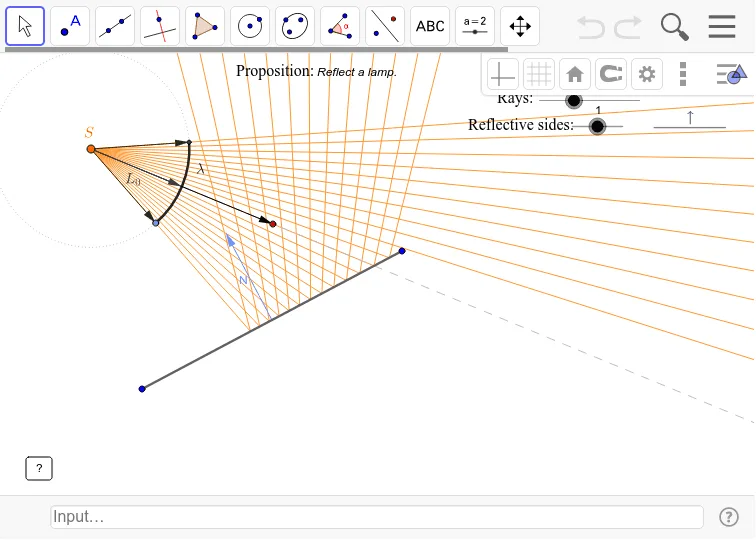
This example demonstrates the reflection of rays off a flat surface (segment). It involves core math concepts like the law of reflection, similar triangles, and vector operations. Construction highlights include using commands like Circle, Point, Ray, Vector, UnitVector, and Segment. Suitable for high school physics or mathematics courses to understand reflection principles and geometric constructions.
GeoGebra Commands & Parameters
Circle(S, 1) → cCircle(S, 2) → fPoint(f) → A_1Ray(S, A_1) → hVector(S, A_1) → aUnitVector(a) → L_0UnitOrthogonalVector(L_0) → uCurveCartesian(x(S + (cos(t) * L_0) + (sin(t) * u)), y(S + (cos(t) * L_0) + (sin(t) * u)), t, -3.14159, 3.141592653589793) → UnitCircleVector(S, B) → b'Vector(S, C) → c'CircumcircleArc(B, S + L_0, C) → λ_2Vector(D, E) → vSegment(D, E) → DEUnitOrthogonalVector(v) → NVector(S, D) → wSequence(z_ε^(k), k, (-n), n) → zεZip(Vector[(z_L * Z)], Z, zε) → LkZip(M ⊗ v, Vector[M], Lk) → DetZip((w ⊗ M) / N, Vector[M], Lk, N, Det) → TimesZip(0 ≤ T ≤ 1 ∧ ((σwv * N) ≥ 0), T, Times, Vector[M], Lk, N, Det) → IsectIndexOf(true, Sort[Isect]) → dexZip(If[n2 ≟ 2, 1, If[n2 ≟ 0, If[X, 0, 1], If[X ∧ σwv ≟ -1, 0, 1]]], X, Isect) → RefOrdinalRank(Ref) → KeyROrdinalRank(Isect) → KeyXZip(If[X, D + (T * v), S], X, Isect, T, Times) → ptsTake(Sort[Rk', KeyR], IndexOf[1, Sort[Ref]], (2 * n) + 1) → RkZip(Ray[P, Vector[V]], P, pts, V, Rk') → raysZip(Segment[S, P], P, Take[Sort[pts, KeyX], dex, (2 * n) + 1]) → segsPoint(UnitCircle) → B'
AI Drawing Prompt Reference
Draw a diagram showing the reflection of light rays off a flat surface, illustrating the incident ray, reflected ray, and normal. Start by drawing a circle and a ray emanating from its center. Next, calculate and plot a unit vector and its orthogonal vector to define the reflecting surface. Near the surface, draw a unit circle and select points on it to simulate reflected rays. Finally, connect the reflection points with line segments to complete the reflection path.
The prompt above was compiled from the original drawing commands and is for reference only.