
Recursive Polygons
Loading the math board and drawing, please wait…
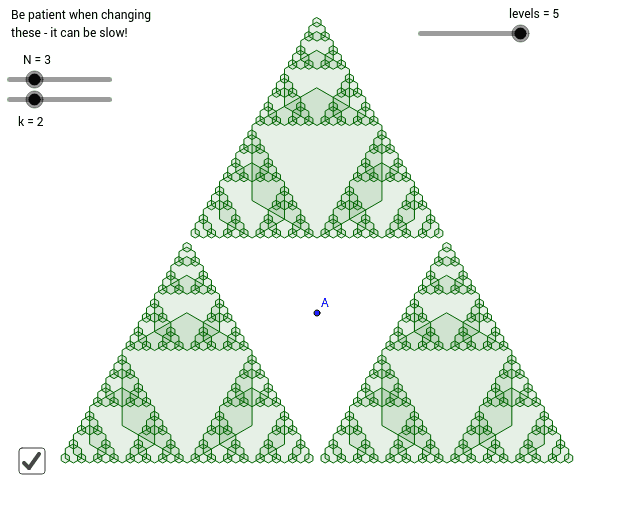
This example demonstrates the recursive construction of hexagons leading to the Sierpinski Triangle, involving recursion, fractal geometry, and stochastic processes. It uses commands like Gens and Sequence, with objects such as N, k, r, f, A, and multiple lists. Suitable for high school students and math enthusiasts exploring fractals and recursion algorithms.
GeoGebra Commands & Parameters
Gens(A, r, N, k) → list1, list2Sequence(Gens[Element[list2, i], (0.5 * r), N, k], i, 1, N) → list3Sequence(Pts[Element[list2, i], (0.5 * r), N, k], i, 1, N) → list4Sequence(Sequence[Pts[Element[list4, i, j], (0.25 * r), N, k], j, 1, N], i, 1, N) → list5Sequence(Sequence[Gens[Element[list4, i, j], (0.25 * r), N, k], j, 1, N], i, 1, N) → list6Sequence(Sequence[Sequence[Pts[Element[list5, i, j, m], (0.125 * r), N, k], m, 1, N], j, 1, N], i, 1, N) → list7Sequence(Sequence[Sequence[Sequence[Pts[Element[list7, i, j, m, p], (0.5^(4) * r), N, k], p, 1, N], m, 1, N], j, 1, N], i, 1, N) → list9Sequence(Sequence[Sequence[Gens[Element[list5, i, j, m], (0.125 * r), N, k], m, 1, N], j, 1, N], i, 1, N) → list8Sequence(Sequence[Sequence[Sequence[Gens[Element[list7, i, j, m, p], (0.5^(4) * r), N, k], p, 1, N], m, 1, N], j, 1, N], i, 1, N) → list10
AI Drawing Prompt Reference
Draw a fractal pattern by recursively constructing hexagons to form the Sierpinski Triangle. Start with an initial hexagon, then recursively generate smaller hexagons at each vertex, repeating the process to create a self-similar geometric structure that demonstrates recursion and fractal geometry.
The prompt above was compiled from the original drawing commands and is for reference only.