
Rectangular Prism Cross Sections by Nicolas ERDRICH
Loading the math board and drawing, please wait…
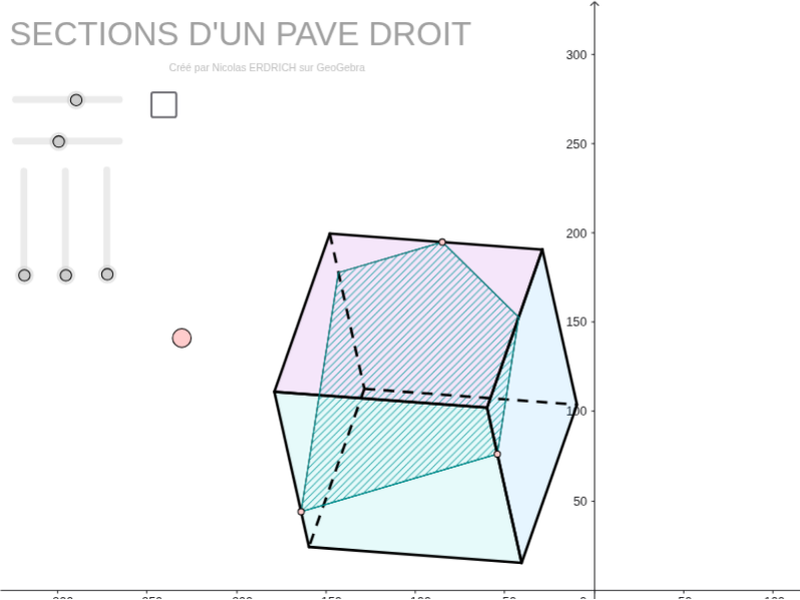
This example demonstrates the changing cross-sectional shapes of a rectangular prism at different angles. It involves core math concepts like solid geometry, vector operations, trigonometry, and coordinate geometry. Construction uses commands like Sequence, Element, Point, Polygon, Segment, Intersect, Line. Suitable for high school and above for understanding spatial geometry and cross-section analysis.
GeoGebra Commands & Parameters
Sequence(Mat * Element[cube, k], k, 1, 8) → cube'Element(Element[AE, 3], 1) → droiteSequence(I + (Element[cube', k, 1, 1], Element[cube', k, 2, 1]), k, 1, 8) → listepointsPoint(listepoints) → CElement(AB, 3, 1) → avantElement(AC, 3, 1) → dessusPoint(listepoints) → JPoint(listepoints) → KPoint(listepoints) → LPolygon(J, K, L, C) → poly7, j_2, k_1, l_1, c_5Point(listepoints) → MPoint(listepoints) → NPolygon(J, M, N, K) → poly8, j_3, m_1, n_1, k_2Point(listepoints) → QPolygon(K, L, Q, N) → poly9, k_3, l_2, q_1, n_2Point(listepoints) → APolygon(J, C, A, M) → poly1, j, c, a_1, mPolygon(Q, A, C, L) → poly2, q, a_2, c_1, lPolygon(A, Q, N, M) → poly3, a_3, q_2, n, m_2Segment(A, M) → a'_1Segment(J, C) → j'_1Segment(K, L) → k'_3Segment(L, Q) → l'_2Segment(M, J) → m'Segment(N, K) → n'_2Segment(Q, N) → q'_1Segment(M, N) → m'_1Segment(Q, A) → q'Segment(K, J) → j'Segment(N, K) → l'Segment(C, L) → l''Segment(C, A) → l''''Segment(M, N) → k''''Segment(C, A) → k'''Point(j_3) → BPoint(l_1) → DPoint(n_1) → EIntersect(l_1, k_1) → FIntersect(c_5, l_1) → GLine(F, G) → dSegment(B, E) → eLine(D, e) → fIntersect(f, c) → HSegment(H, D) → gSegment(B, H) → hLine(E, h) → iIntersect(d, i) → OIntersect(i, k_1) → RSegment(R, D) → kSegment(E, R) → pLine(D, e) → rIntersect(r, l'_2) → SSegment(E, S) → sLine(B, s) → tIntersect(t, c_5) → TSegment(T, D) → b_1Segment(B, T) → d_1Segment(D, S) → e_1Polygon(B, E, S, D, T) → poly4, b_2, e_2, s_1, d_2, t_1Polygon(B, E, R, D, H) → poly5, b_3, e_3, r_1, d_3, h_1
AI Drawing Prompt Reference
This is a geometric figure demonstrating the changing cross-sectional shapes of a rectangular prism at different angles. The figure is generated from a cube, using a sequence of points to define the sections. Key objects include a cube, a point C, a point J, a point K, a point L, and multiple polygons such as poly7, poly8, poly9, which represent different cross-sectional shapes. The construction order starts from generating a point list from the cube, then creating these polygons, and finally connecting points with line segments to define the figure structure. The figure illustrates spatial geometry and cross-section analysis concepts, suitable for high school and above.
The prompt above was compiled from the original drawing commands and is for reference only.