
Cube and Diagonal
Loading the math board and drawing, please wait…
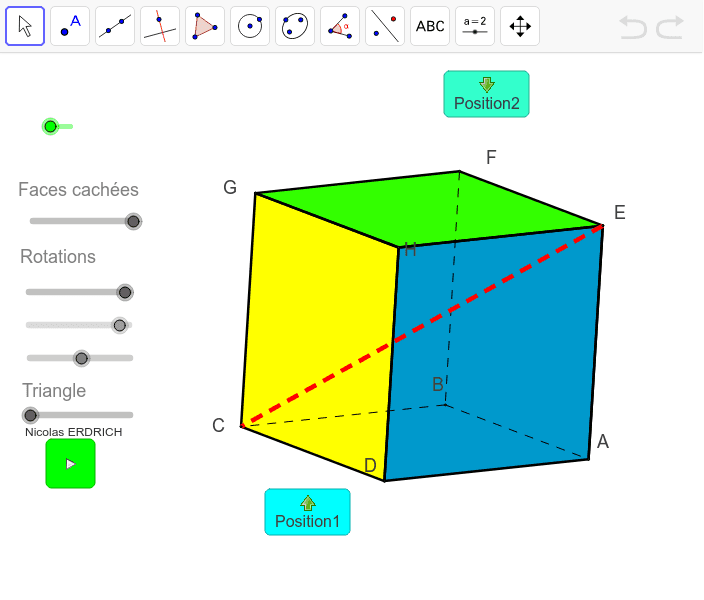
This example demonstrates the geometric relationships and calculations of a cube and its space diagonals. Core math concepts include solid geometry, vector, trigonometry, and spatial coordinate transformations. Construction highlights use of GeoGebra commands like Sequence, Element, Point, Polygon, Segment, Matrix, and Transform. Suitable for high school and above students for teaching and visual exploration of solid geometry and spatial transformations.
GeoGebra Commands & Parameters
Sequence((Mat * Element[cube, k]), k, 1, 8) → cube'Element(Element[AE, 3], 1) → droiteSequence(I + (Element[cube', k, 1, 1], Element[cube', k, 2, 1]), k, 1, 8) → listepointsPoint(listepoints) → EElement(AB, 3, 1) → avantElement(AC, 3, 1) → dessusPoint(listepoints) → HPoint(listepoints) → GPoint(listepoints) → FPolygon(H, G, F, E) → poly7, j_2, k_1, l_1, c_5Point(listepoints) → DPoint(listepoints) → CPolygon(H, D, C, G) → poly8, j_3, m_1, n_1, k_2Point(listepoints) → BPolygon(G, F, B, C) → poly9, k_3, l_2, q_1, n_2Point(listepoints) → APolygon(H, E, A, D) → poly1, j, c, a_1, mPolygon(B, A, E, F) → poly2, q, a_2, c_1, lPolygon(A, B, C, D) → poly3, a_3, q_2, n, m_2Segment(A, D) → a'_1Segment(H, E) → j'_1Segment(G, F) → k'_3Segment(F, B) → l'_2Segment(D, H) → m'Segment(C, G) → n'_2Segment(B, C) → q'_1Segment(D, C) → m'_1Segment(B, A) → q'Segment(G, H) → j'Segment(C, G) → l'Segment(E, F) → l''Segment(E, A) → l''''Segment(D, C) → k''''Segment(E, A) → k'''Segment(A, C) → gSegment(E, C) → rhSegment(C, A) → segPoint(k_1) → JPoint(a_1) → KPoint(c_5) → LSegment(K, L) → rkSegment(J, L) → rp
AI Drawing Prompt Reference
Draw a cube and its space diagonals. First, construct the eight vertices of the cube and connect them to form the cube's faces. Then, identify and highlight the space diagonals of the cube using different colors or line styles. Finally, combine these diagonals with the cube's edges to showcase the three-dimensional structure and the geometric relationship between the diagonals and the cube.
The prompt above was compiled from the original drawing commands and is for reference only.