
Rectangle Similarity: Exploring Similarity via Rotation, Reflection, and Scaling
Loading the math board and drawing, please wait…
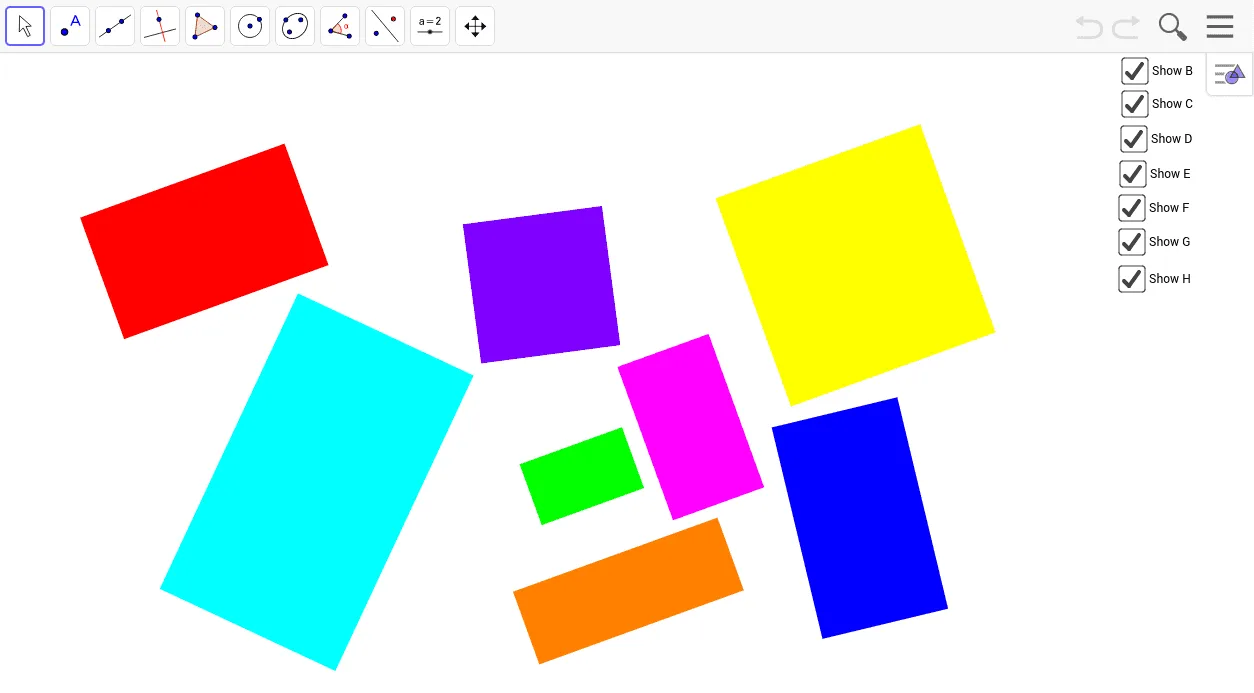
This example demonstrates how to construct and verify the similarity of two rectangles through geometric transformations. The core mathematical concepts are similarity transformations, including rotation, reflection (mirror), and dilation (scaling), along with properties of similar polygons. Construction highlights: using commands such as Segment, OrthogonalLine, Point, Intersect, Angle, Polygon to build the original rectangle and its angles; applying Line, Mirror, Rotate, and Dilate to transform the rectangle into a new one; then using Angle and Polygon to measure and compare corresponding angles and side ratios, thereby verifying similarity. This is suitable for upper middle school or high school students to intuitively understand the criteria for similar figures and the use of transformation tools in dynamic geometry software.
GeoGebra Commands & Parameters
Segment(A, B) → aOrthogonalLine(A, a) → bOrthogonalLine(B, a) → cPoint(b) → DOrthogonalLine(D, b) → dIntersect(c, d) → CSegment(D, A) → eSegment(D, C) → fSegment(C, B) → gAngle(C, B, A) → αAngle(B, A, D) → βAngle(A, D, C) → γAngle(D, C, B) → δPolygon(A, B, C, D) → poly1, a_1, b_1, c_1, d_1Line(E, F) → hMirror(A, h) → A'Mirror(B, h) → B'Mirror(C, h) → C'Mirror(D, h) → D'Polygon(A', B', C', D') → poly1', a', b', c', d'Point(Circle[G, Segment[B', C']]) → HRotate(H + (Segment[C', D'], 0), Angle[D' - C'] + Angle[H - G] - Angle[C' - B'], H) → IRotate(I + (Segment[D', A'], 0), Angle[A' - D'] + Angle[I - H] - Angle[D' - C'], I) → JPolygon(G, H, I, J) → poly3, g_1, h_1, i, jDilate(A, 0.5, K) → A'_1Dilate(B, 0.5, K) → B'_1Dilate(C, 0.5, K) → C'_1Dilate(D, 0.5, K) → D'_1Segment(A_1, B_1) → a_2OrthogonalLine(A_1, a_2) → b_2OrthogonalLine(B_1, a_2) → c_2Point(b_2) → D_1OrthogonalLine(D_1, b_2) → d_2Intersect(c_2, d_2) → C_1Segment(D_1, A_1) → e_1Segment(D_1, C_1) → f_1Segment(C_1, B_1) → g_2Angle(C_1, B_1, A_1) → α_1Angle(B_1, A_1, D_1) → β_1Angle(A_1, D_1, C_1) → γ_1Angle(D_1, C_1, B_1) → δ_1Dilate(A_1, 0.5, K_1) → A'_2Dilate(B_1, 0.5, K_1) → B'_2Dilate(C_1, 0.5, K_1) → C'_2Dilate(D_1, 0.5, K_1) → D'_2Dilate(A, 0.5, L) → A'_3Dilate(B, 0.5, L) → B'_3Dilate(C, 0.5, L) → C'_3Dilate(D, 0.5, L) → D'_3Segment(A_2, B_2) → a_4OrthogonalLine(A_2, a_4) → b_4OrthogonalLine(B_2, a_4) → c_4Point(b_4) → D_2OrthogonalLine(D_2, b_4) → d_4Intersect(c_4, d_4) → C_2Segment(D_2, A_2) → e_2Segment(D_2, C_2) → f_2Segment(C_2, B_2) → g_3Angle(C_2, B_2, A_2) → α_2Angle(B_2, A_2, D_2) → β_2Angle(A_2, D_2, C_2) → γ_2Angle(D_2, C_2, B_2) → δ_2Dilate(A_2, 0.5, L_1) → A'_4Dilate(B_2, 0.5, L_1) → B'_4Dilate(C_2, 0.5, L_1) → C'_4Dilate(D_2, 0.5, L_1) → D'_4Polygon(A'_4, B'_4, C'_4, D'_4) → poly1'_3, a'_1, b'_1, c'_1, d'_1Dilate(A, 1.5, M) → A'_5Dilate(B, 1.5, M) → B'_5Dilate(C, 1.5, M) → C'_5Dilate(D, 1.5, M) → D'_5Rotate(A'_5, 45°, N) → ORotate(B'_5, 45°, N) → PRotate(C'_5, 45°, N) → QRotate(D'_5, 45°, N) → RSegment(A_3, B_3) → a_3OrthogonalLine(A_3, a_3) → b_3OrthogonalLine(B_3, a_3) → c_3Point(b_3) → D_3OrthogonalLine(D_3, b_3) → d_3Intersect(c_3, d_3) → C_3Segment(D_3, A_3) → e_3Segment(D_3, C_3) → f_3Segment(C_3, B_3) → g_4Angle(C_3, B_3, A_3) → α_3Angle(B_3, A_3, D_3) → β_3Angle(A_3, D_3, C_3) → γ_3Angle(D_3, C_3, B_3) → δ_3Dilate(A_3, 1.5, M_1) → A'_6Dilate(B_3, 1.5, M_1) → B'_6Dilate(C_3, 1.5, M_1) → C'_6Dilate(D_3, 1.5, M_1) → D'_6Rotate(A'_6, 45°, N_1) → O_1Rotate(B'_6, 45°, N_1) → P_1Rotate(C'_6, 45°, N_1) → Q_1Rotate(D'_6, 45°, N_1) → R_1Polygon(O_1, P_1, Q_1, R_1) → poly2_1, o_1, p_1, q_1, r_1Dilate(A, 0.75, S) → A'_7Dilate(B, 0.75, S) → B'_7Dilate(C, 0.75, S) → C'_7Dilate(D, 0.75, S) → D'_7Rotate(A'_7, 90°, T) → URotate(B'_7, 90°, T) → VRotate(C'_7, 90°, T) → WRotate(D'_7, 90°, T) → ZSegment(A_4, B_4) → a_5OrthogonalLine(A_4, a_5) → b_5OrthogonalLine(B_4, a_5) → c_5Point(b_5) → D_4OrthogonalLine(D_4, b_5) → d_5Intersect(c_5, d_5) → C_4Segment(D_4, A_4) → e_4Segment(D_4, C_4) → f_4Segment(C_4, B_4) → g_5Angle(C_4, B_4, A_4) → α_4Angle(B_4, A_4, D_4) → β_4Angle(A_4, D_4, C_4) → γ_4Angle(D_4, C_4, B_4) → δ_4Polygon(A_4, B_4, C_4, D_4) → poly1_1, a_6, b_6, c_6, d_6Dilate(A_4, 0.75, S_1) → A'_8Dilate(B_4, 0.75, S_1) → B'_8Dilate(C_4, 0.75, S_1) → C'_8Dilate(D_4, 0.75, S_1) → D'_8Polygon(A'_8, B'_8, C'_8, D'_8) → poly1'_2, a'_2, b'_2, c'_2, d'_2Rotate(A'_8, 90°, T_1) → U_1Rotate(B'_8, 90°, T_1) → V_1Rotate(C'_8, 90°, T_1) → W_1Rotate(D'_8, 90°, T_1) → Z_1Polygon(U_1, V_1, W_1, Z_1) → poly2_2, u_1, v_1, w_1, z_2Polygon(E_2, F_2, 4) → poly2_3, p_2, q_2, r_2, s_1, G_2, H_2Segment(A_5, B_5) → a_9OrthogonalLine(A_5, a_9) → b_9OrthogonalLine(B_5, a_9) → c_7Point(b_9) → D_5OrthogonalLine(G_3, b_9) → p_3Intersect(b_9, p_3) → H_3Intersect(c_7, p_3) → I_2Polygon(A_5, H_3, I_2, B_5) → poly2_4, a_8, h_3, i_2, b_8Segment(A_6, B_6) → a_{11}OrthogonalLine(A_6, a_{11}) → b_{11}OrthogonalLine(B_6, a_{11}) → c_8Point(b_{11}) → D_6OrthogonalLine(G_4, b_{11}) → p_4Intersect(b_{11}, p_4) → H_4Intersect(c_8, p_4) → I_3Polygon(A_6, H_4, I_3, B_6) → poly2_5, a_{10}, h_4, i_3, b_{10}