
Rectangle, Rhombus, Square: Geometric Construction and Classification (1)
Loading the math board and drawing, please wait…
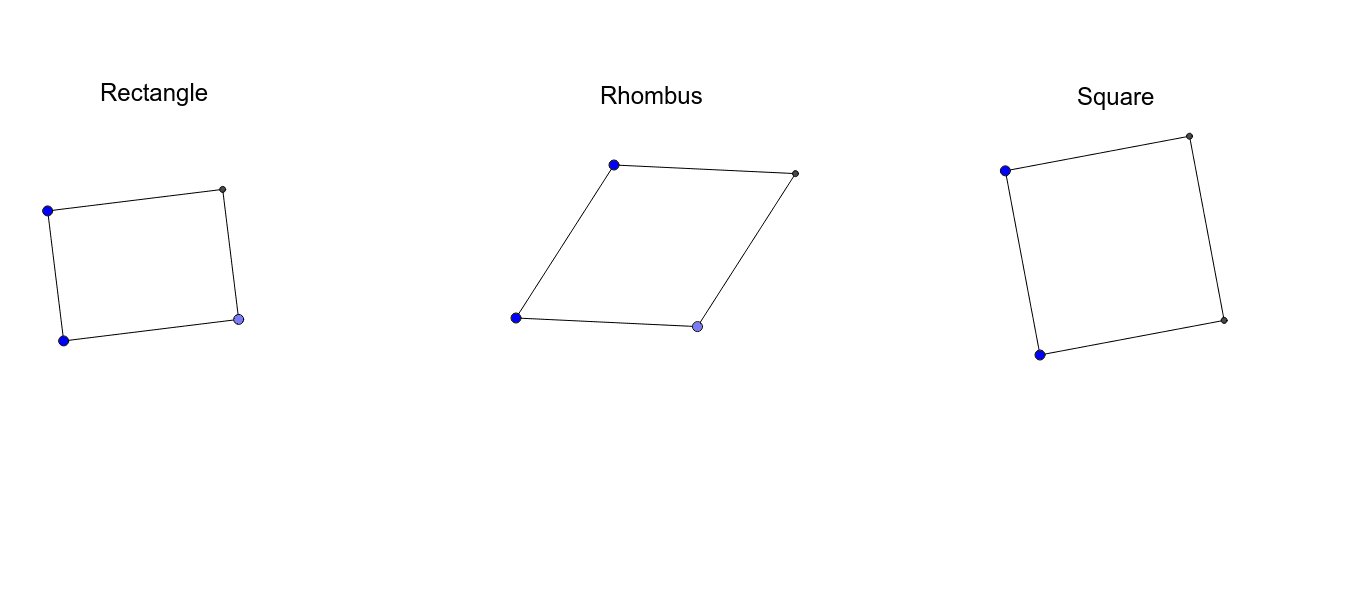
This GeoGebra example dynamically demonstrates the geometric construction and properties of rectangles, rhombi, and squares as special types of parallelograms. The core mathematical concepts include parallelogram definitions, diagonal properties, side-angle relationships, and classification criteria for quadrilaterals. Construction details: using commands such as Segment, Circle, OrthogonalLine, Intersect, Point, and Line, the example constructs points A, B, segments a and c, circle b, perpendicular lines d and e, intersections C and D, then further perpendicular lines f, g, h, i to generate points E, F, G, H, etc., with text objects labeling each element. This resource is suitable for middle school geometry lessons to help students intuitively understand the inclusion relationships and theorems among rectangles, rhombi, and squares, and can also serve as a review tool for high school plane geometry.
GeoGebra Commands & Parameters
Segment(A, B) → aCircle(B, A) → cOrthogonalLine(B, a) → bIntersect(c, b, 2) → COrthogonalLine(A, a) → dOrthogonalLine(C, b) → eIntersect(d, e) → DSegment(B, C) → fSegment(C, D) → gSegment(D, A) → hSegment(A, D) → iSegment(E, F) → jOrthogonalLine(E, j) → kOrthogonalLine(F, j) → lPoint(l) → GOrthogonalLine(G, l) → mIntersect(k, m) → HSegment(E, H) → nSegment(H, G) → pSegment(G, F) → qSegment(I, J) → rCircle(J, I) → sPoint(s) → KSegment(J, K) → tLine(I, t) → a_1Line(K, r) → b_1Intersect(a_1, b_1) → LSegment(I, L) → c_1Segment(L, K) → d_1
AI Drawing Prompt Reference
Draw a set of quadrilaterals derived from parallelogram classification. Start with a horizontal base segment, draw a circle centered at one endpoint with radius equal to the base, construct a perpendicular line through the center, intersect it with the circle to get a point, then draw another perpendicular through that point and intersect with the perpendicular at the other endpoint to form the first rectangle. Above this, construct a second rectangle using two new points. Then, using a segment as a side, construct a rhombus by drawing a circle, picking a point on it, connecting to form sides, and drawing parallel lines to complete the shape. Finally, label the three special quadrilaterals as rectangle, rhombus, and square to show their inclusion relationships.
The prompt above was compiled from the original drawing commands and is for reference only.