
Rectangle as Parallelogram
Loading the math board and drawing, please wait…
In collections
Quadrilaterals الرُباعيات
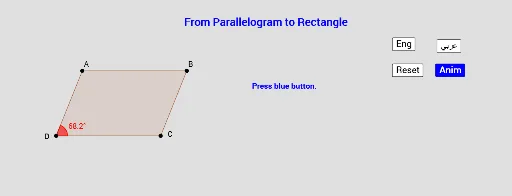
This example demonstrates the geometric relationship between a rectangle and a parallelogram, illustrating that a rectangle is a special parallelogram with right angles. Key mathematical concepts include quadrilateral classification, parallel line properties, angle relationships (α, β, γ, δ), and vector translation transformations. Construction uses Vector for direction and displacement, Translate for moving figures, Segment and Polygon to build quadrilateral objects, and Angle to measure interior angles. Interactive buttons and text controls enable multilingual support (English/Arabic) and answer display. Suitable for middle to high school geometry instruction, ideal for visualizing quadrilateral property theorems and transformation concepts.
GeoGebra Commands & Parameters
Vector((-2, 0)) → vTranslate(B1, Vector[(h * v)]) → BTranslate(A1, Vector[(h * v)]) → ASegment(A, B) → a'Segment(D, A) → d'Segment(C, B) → b'Polygon(A, B, C, D) → poly2, a'_1, b'_1, c, dAngle(C, D, A) → αAngle(A, B, C) → βAngle(B, C, D) → γAngle(D, A, B) → δ
AI Drawing Prompt Reference
Draw a rectangle and a parallelogram to demonstrate that a rectangle is a special type of parallelogram with right angles. Use vectors to represent direction and displacement, and apply translation transformations to construct the parallelogram. Measure and label the interior angles α, β, γ, δ to illustrate the angle relationships and vector transformations. The image should include both a rectangle and a parallelogram, along with annotated angles and vectors, suitable for geometry instruction.
The prompt above was compiled from the original drawing commands and is for reference only.