
Rectangle Area Calculation Demo
Loading the math board and drawing, please wait…
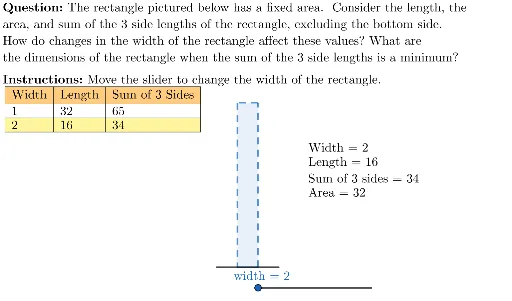
This example demonstrates how to calculate the area of a rectangle through dynamic geometry. It involves core math concepts like area, rectangle, plane geometry, division, reflection, square, and special points. Construction highlights include commands like Point, Join, LaTeX, Polygon, Sequence, TableText, and Segment in GeoGebra. Suitable for middle school and above students to learn geometric area calculation methods.
GeoGebra Commands & Parameters
Point(Segment[(2, 0), (13, 0)]) → SJoin({Sequence["white", i, 1, width - 1], {"#fff59d"}, Sequence["white", i, width + 1, Max[13, width + 1]]}) → RowColoursLaTeX("\text{\textbf{Instructions: }Move the slider to change the width of the rectangle.}") → SpecInstrucPolygon(D, A, B, C) → q1, d, a, b, cSequence(Sequence[(((("\cellcolor{" * Element[RowColours, j]) * "}{") * Element[tblVals, i, j]) * "}"), i, 1, 3], j, 1, maxWidth) → ListDataJoin({ListHeader, ListData}) → FullListTableText(FullList, "|111_111111111111l") → displayTblSegment(A + (-2, 0), B + (2, 0)) → baseLaTeX((((((((((("\text{Width = }" * width) * "\\") * "\text{Length = }") * length) * "\\") * "\text{Sum of 3 sides = }") * sum3Sides) * "\\") * "\text{Area = }") * fixedArea)) → DisplayOutputLaTeX("\text{\textbf{Question: }The rectangle pictured below has a fixed area. Consider the length, the \\area, and sum of the \(3\) side lengths of the rectangle, excluding the bottom side. \\How do changes in the width of the rectangle affect these values? What are \\the dimensions of the rectangle when the sum of the \(3\) side lengths is a minimum?}") → MainInstrucLaTeX(((MainInstruc * "\\") * SpecInstruc)) → CompleteInstrucSegment((2, 0), (13, 0)) → mySlider