
Reciprocal Trigonometric Functions on the Unit Circle
Loading the math board and drawing, please wait…
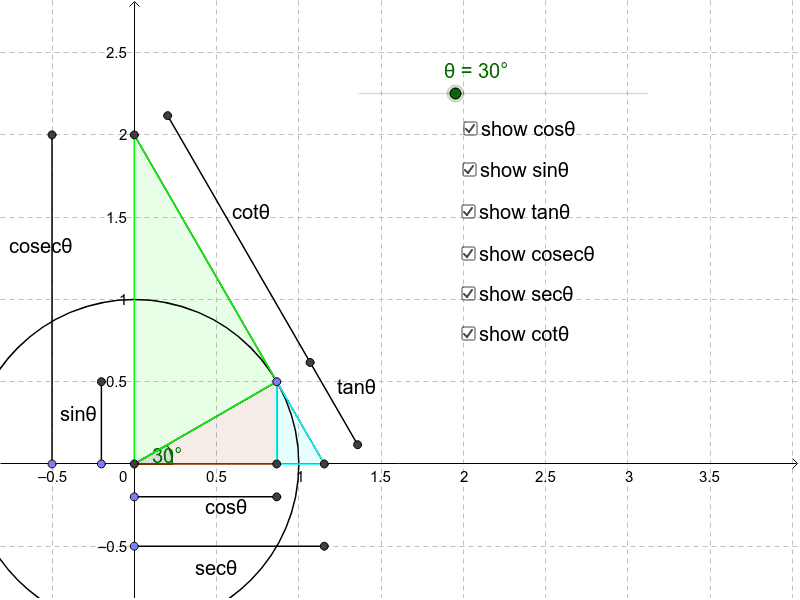
This GeoGebra example geometrically demonstrates the definition and visual representation of reciprocal trigonometric functions (secant, cosecant, cotangent) on the unit circle. Core mathematical concepts include the unit circle, trigonometric ratios, triangle similarity, and the algebraic relationships between sine, cosine, tangent, and their reciprocals. The construction utilizes key GeoGebra commands such as Intersect, Circle, Rotate, Angle, Segment, OrthogonalLine, and Polygon to dynamically generate geometric objects (points, segments, and polygons) corresponding to key trigonometric values like cosθ, sinθ, secθ, and cosecθ. It is suitable for high school and introductory college-level trigonometry and geometry courses to provide geometric intuition for reciprocal identities.
GeoGebra Commands & Parameters
Intersect(xAxis, yAxis) → APoint(yAxis) → BPoint(xAxis) → CCircle(A, B) → cRotate(C, θ, A) → C'Angle(C, A, C') → αSegment(A, C') → aOrthogonalLine(C', a) → bIntersect(b, xAxis) → DIntersect(b, yAxis) → EOrthogonalLine(C', xAxis) → dOrthogonalLine(C', yAxis) → ePoint(yAxis) → FPoint(xAxis) → GOrthogonalLine(G, e) → fOrthogonalLine(F, d) → gIntersect(e, f) → HIntersect(d, g) → ISegment(F, I) → cosθPoint(yAxis) → JPoint(xAxis) → KOrthogonalLine(K, xAxis) → iOrthogonalLine(J, f) → jOrthogonalLine(E, yAxis) → kOrthogonalLine(D, xAxis) → lIntersect(i, k) → LSegment(L, K) → cosecθIntersect(j, l) → MSegment(H, G) → sinθIntersect(d, xAxis) → NSegment(C', N) → pSegment(J, M) → secθSegment(E, D) → rOrthogonalLine(E, r) → sOrthogonalLine(C', r) → tOrthogonalLine(D, r) → a_1Point(yAxis) → OCircle(A, O) → c_1Intersect(c_1, t, 2) → POrthogonalLine(P, t) → b_1Intersect(s, b_1) → QIntersect(a_1, b_1) → RSegment(Q, P) → cotθSegment(P, R) → tanθPolygon(A, C', N) → poly1, n, a_2, c'Polygon(N, C', D) → poly2, d_1, n_1, c'_1Polygon(A, C', E) → poly3, e_1, a_3, c'_2
AI Drawing Prompt Reference
Draw a unit circle centered at the origin. Mark an angle θ from the positive x‑axis to a point on the circle. From that point drop perpendiculars to the x‑ and y‑axes, and extend lines to form the secant, cosecant, and cotangent segments. Use the resulting similar right triangles to illustrate the geometric definitions of sin θ, cos θ, tan θ, cot θ, sec θ, and csc θ, showing how their lengths change dynamically as θ varies.
The prompt above was compiled from the original drawing commands and is for reference only.