
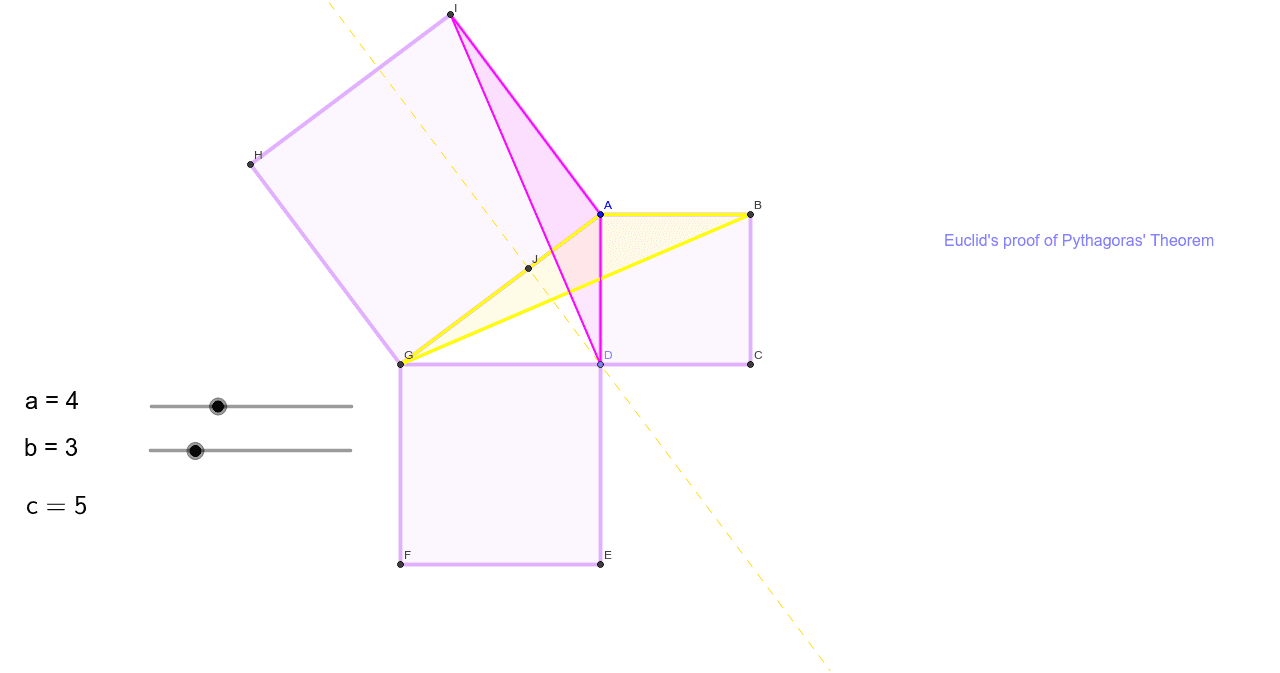
Step 1 of Euclid's Proof of Pythagoras' Theorem
Loading the math board and drawing, please wait…
This example demonstrates the first step of Euclid's proof of Pythagoras' Theorem. Students need to prove the congruence of triangles using SAS. It involves constructing triangles, segments, polygons, etc., to visually understand the core concept of the Pythagorean Theorem. Commands used include Intersect, Segment, Polygon, Distance, Perimeter, etc. Suitable for middle school and above students to learn geometric proofs.
GeoGebra Commands & Parameters
Intersect(xAxis, yAxis) → GSegment(G, D) → aSegment(D, A) → bSegment(G, A) → cPolygon(G, A, 4) → poly1, d, e, f, g, I, HPolygon(A, D, 4) → poly2, h, i, j, k, C, BPolygon(D, G, 4) → poly3, l, m, n, p, F, EPolygon(G, D, A) → poly4, c_1, a_1, b_1Distance(G, A) → distanceACPerimeter(poly1) → perimeterpoly1Polygon(I, D, A) → poly5, a_2, d_1, d_2Polygon(A, G, B) → poly6, b_2, a_3, g_1OrthogonalLine(D, c) → qIntersect(q, c) → JPolygon(A, G, B) → poly7, b_3, a_4, g_2Polygon(D, I, A) → poly8, a_5, d_3, i_1
AI Drawing Prompt Reference
Draw a right triangle with labeled legs, and construct squares on each leg. Connect the right angle vertex to the intersection points of the squares' circumcircles. Use a slider to adjust the triangle size dynamically, observing the area changes in the squares to visualize the Pythagorean theorem.
The prompt above was compiled from the original drawing commands and is for reference only.