
Radius and Chord: Exploring Circle Segment Relationships
Loading the math board and drawing, please wait…
In collections
Circle Terms
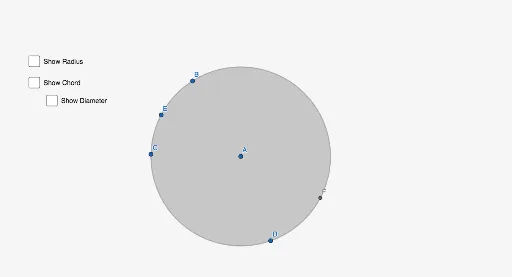
This example demonstrates the fundamental geometric relationships between a radius and a chord in a circle, showing that the perpendicular bisector of a chord passes through the center and that a radius perpendicular to a chord bisects it. Core mathematical concepts include the definition of a circle, chords, radii, the perpendicular bisector theorem, and point-line relationships. Construction details: using GeoGebra commands such as Circle to create the circle, Segment to draw the chord, Point to mark intersection points, Line to construct auxiliary lines, and Intersect to find intersections, involving objects like center A, circle c, chord f, points C/D/E, line g, point F, lines h/i, and segments a/b/d. Suitable for middle school geometry or introductory high school analytic geometry, helping students intuitively understand circle segment relationships and develop geometric construction skills.
GeoGebra Commands & Parameters
Circle(A, B) → cSegment(A, B) → fPoint(c) → CPoint(c) → DPoint(c) → ELine(A, E) → gIntersect(c, g, 2) → FSegment(F, E) → hSegment(C, D) → i
AI Drawing Prompt Reference
Draw a circle with its center marked. Construct a radius from the center to a point on the circle. Pick three arbitrary points on the circle. Connect two of them to form a chord. From the center, draw a line through the third point, extending to meet the circle again at another point, and connect these two intersection points to form a segment. Finally, connect the first two points to form another chord. The figure shows a circle, a radius, two chords, and a line through the center, illustrating the perpendicular bisector relationship between radius and chord.
The prompt above was compiled from the original drawing commands and is for reference only.