
Radians, Number Line and the Unit Circle by Irina Boyadzhiev
Loading the math board and drawing, please wait…
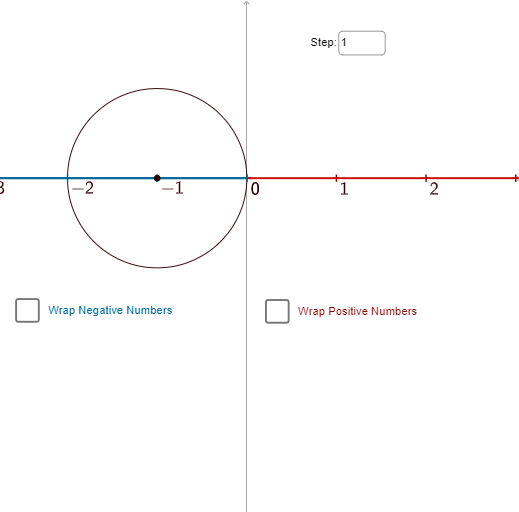
This example demonstrates the one-to-one correspondence between points on the number line and points on the unit circle. It involves core mathematical concepts such as radians, trigonometric functions, the unit circle, and the number line. The construction utilizes GeoGebra commands/objects like Vector, Text, Length, Intersect, Point, Circle, If, Rotate, Tangent, Ray, UnitVector, Sequence, CircleArc, Take, Segment, Textfield, and CurveCartesian. It is suitable for high school mathematics education, helping students understand the connection between trigonometric functions and the unit circle, ideal for learners of analytical geometry and trigonometry.
GeoGebra Commands & Parameters
Vector((0, 0), (1, 0)) → u_1Text(A50) → B50Text(A49) → B49Text(A48) → B48Text(A47) → B47Text(A46) → B46Text(A45) → B45Text(A44) → B44Text(A43) → B43Text(A42) → B42Text(A41) → B41Text(A40) → B40Text(A39) → B39Text(A38) → B38Text(A37) → B37Text(A36) → B36Text(A35) → B35Text(A34) → B34Text(A33) → B33Text(A32) → B32Text(A31) → B31Text(A30) → B30Text(A29) → B29Text(A28) → B28Text(A27) → B27Text(A26) → B26Text(A25) → B25Text(A24) → B24Text(A23) → B23Text(A22) → B22Text(A21) → B21Text(A20) → B20Text(A19) → B19Text(A18) → B18Text(A17) → B17Text(A16) → B16Text(A15) → B15Text(A14) → B14Text(A13) → B13Text(A12) → B12Text(A11) → B11Text(A10) → B10Text(A9) → B9Text(A8) → B8Text(A7) → B7Text(A6) → B6Text(A5) → B5Text(A4) → B4Text(A3) → B3Text(A2) → B2Text(A1) → B1Length(numb) → lIntersect(xAxis, yAxis) → BPoint(xAxis) → OCircle(O, B) → cIf(WrapPositive ≥ pi / 2, WrapPositive - pi / 2, 0) → fRotate(M, f, O) → M'Tangent(M', c) → b,Point(b) → DRay(M', D) → eUnitVector(e) → uPoint(xAxis) → CIf(WrapPositive ≤ pi / 2, WrapPositive, 1.5707963267948966) → αRotate(B, α, B) → B'Rotate(C, α, B) → C'Ray(B', C') → a'Rotate(B', f, B) → B''Sequence(Point[M', Vector[If[(k * st) - f ≥ 0, Vector[(u * ((k * st) - f))]]]], k, 0, l) → list1CircleArc(O, M, M') → dIf(f ≟ 0, RemoveUndefined[list1], Append[(0, 0), RemoveUndefined[list1]]) → ptsRSequence((cos(k) - 1, sin(k)), k, 0, f, st) → ptsCCircle(O, B) → gUnitVector(a') → vSequence(Point[M, Vector[((k * st) * v)]], k, 0, l) → list2Sequence(Text[Element[numb, k + W + 1], Element[ptsR, k + 1], true, true], k, 0, l - 1) → numRTake(numR, 2) → NewPtsRPoint(c) → ASegment(O, A) → iiRotate(A, WrapPositive) → A'If(WrapPositive > pi / 2, Segment[Rotate[O, WrapPositive - pi / 2, O], Rotate[A, WrapPositive - pi / 2, O]]) → jTextfield(st) → inputBox1Rotate(A, 6.2831, O) → A'_1Sequence(Text[Element[numb, k], Element[list2, k], true, true], k, 1, l) → nmbXTake(Sequence[Text[Element[numb, k], Element[ptsC, k], true, true], k, 1, l], 2) → numCText(C1) → D1Text(C2) → D2Text(C3) → D3Text(C4) → D4Text(C5) → D5Text(C6) → D6Text(C7) → D7Text(C8) → D8Text(C9) → D9Text(C10) → D10Text(C11) → D11Text(C12) → D12Text(C13) → D13Text(C14) → D14Text(C15) → D15Text(C16) → D16Text(C17) → D17Text(C18) → D18Text(C19) → D19Text(C20) → D20Text(C21) → D21Text(C22) → D22Text(C23) → D23Text(C24) → D24Text(C25) → D25Text(C26) → D26Text(C27) → D27Text(C28) → D28Text(C29) → D29Text(C30) → D30Text(C31) → D31Text(C32) → D32Text(C33) → D33Text(C34) → D34Text(C35) → D35Text(C36) → D36Text(C37) → D37Text(C38) → D38Text(C39) → D39Text(C40) → D40Text(C41) → D41Text(C42) → D42Text(C43) → D43Text(C44) → D44Text(C45) → D45Text(C46) → D46Text(C47) → D47Text(C48) → D48Text(C49) → D49Text(C50) → D50If(WrapNegative ≤ pi / 2, WrapNegative, 1.5707963267948966) → εRay(A, O) → kIf(WrapNegative > pi / 2 + 0.5, WrapNegative - pi / 2 - 0.5, 0) → mRotate(A, ε, M) → A'_2Rotate(O, ε, M) → O'Ray(A'_2, O') → k'UnitVector(k') → wSequence(Point[M, Vector[((i * st) * w)]], i, 0, l) → ptsXNRotate(M, (-m), O) → MMTangent(MM, c) → n,Point(n) → FRay(MM, F) → pUnitVector(p) → qSequence(Point[MM, Vector[If[(k * st) - m ≥ 0, Vector[(q * ((k * st) - m))]]]], k, 0, l) → ptsRNIf(m ≟ 0, RemoveUndefined[ptsRN], Append[(0, 0), RemoveUndefined[ptsRN]]) → ptsRN_1Take(Sequence[Text[Element[numbN, k + WN + 1], Element[ptsRN_1, k + 1], true, true], k, 0, l - 1], 2) → numRNCircleArc(O, MM, M) → rSequence((cos(k) - 1, (-sin(k))), k, 0, m, st) → ptsCNTake(Sequence[Text[Element[numbN, k], Element[ptsCN, k], true, true], k, 1, l], 2) → numCNSequence(Text[Element[numbN, k], Element[ptsXN, k], true, true], k, 1, l) → numXNIf(WrapPositive > pi / 2, Segment[Rotate[O, WrapPositive - pi / 2, O], Rotate[A, WrapPositive - pi / 2, O]]) → sCircle(O, B) → c_1Segment(O, A) → a_1If(a ≟ false ∧ h ≟ false, true, false) → startSequence(Point[M, Vector[((i * st) * u_1)]], i, 0, l) → ptsXPRay(M, C) → b_1Sequence(Text[Element[numb, k], Element[ptsXP, k], true, true], k, 1, l) → list3Ray(A, O) → d_1Vector((0, 0), (-1, 0)) → v_1Sequence(Point[M, Vector[((i * st) * v_1)]], i, 0, l) → ptsXNSSequence(Text[Element[numbN, k], Element[ptsXNS, k], true, true], k, 1, l) → list4CurveCartesian(((0.2 / 16 * (t + (6 * pi))) * cos(t + (6 * pi))) - 1, ((0.2 / 16 * (t + (6 * pi))) * sin(t + (6 * pi))), t, 0, WrapPositive - pi / 2) → oTangent(End, o) → e_1UnitVector(e_1) → w_1Vector(End, Point[End, Vector[(0.12 * w_1)]]) → f_1CurveCartesian(((0.2 / 16 * (t + (6 * pi))) * cos(t + (6 * pi))) - 1, ((-0.2 / 16 * (t + (6 * pi))) * sin(t + (6 * pi))), t, 0, WrapNegative - pi / 2 - 0.5) → j_1Tangent(K, j_1) → iUnitVector(i) → g_1Vector(K, Point[K, Vector[(0.12 * g_1)]]) → h_1If(WrapNegative > pi / 2 + 0.5, Segment[Rotate[O, (-WrapNegative) + pi / 2 + 0.5, O], Rotate[A, (-WrapNegative) + pi / 2 + 0.5, O]]) → t
AI Drawing Prompt Reference
Draw a horizontal number line and mark multiple equally spaced points from -2π to 2π on it, labeling each with its radian value. Draw a unit circle centered at the origin and a ray starting from the origin that aligns with the number line. Mark points on the ray at unit distances from the origin and connect each point to its corresponding point on the unit circle. Label the points on the unit circle corresponding to special angles like 0°, 30°, 45°, 60°, 90° with their coordinates.
The prompt above was compiled from the original drawing commands and is for reference only.