
Quirinus Puzzle
Loading the math board and drawing, please wait…
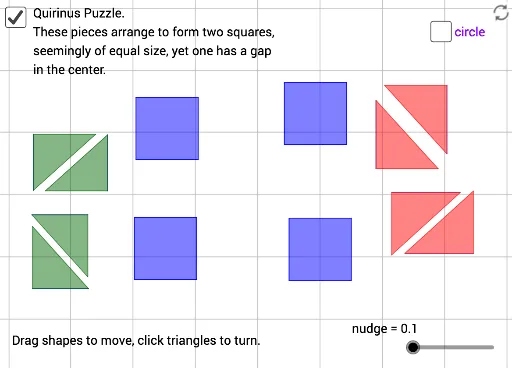
This is a lovely paradox puzzle that demonstrates the concepts of area and similarity transformation. Using GeoGebra, we can construct a series of geometric shapes, including circles, polygons, and parametric curves. The example involves core math concepts such as similarity, area calculation, and percentages. Suitable for middle school and above students to learn geometric construction and related concepts.
GeoGebra Commands & Parameters
Point(Circle[O, 1 + o]) → PSegment(O, P) → g_1Segment(A, B) → fPolygon(A, B, 4) → poly1, g, h, i, j, C_1, D_1Segment(E, F) → kSegment(C, D) → lSegment(G, H) → mPolygon(E, F, 4) → poly2, n, p, q, r, I, JPolygon(C, D, 4) → poly3, s, t, a, b, K, LPolygon(G, H, 4) → poly4, c, d, e, f_1, M, NPoint(Circle[Q, 1 + o]) → RSegment(Q, R) → h_1Point(Circle[S, 1 + o]) → TSegment(S, T) → i_1Point(Circle[U, 1 + o]) → VSegment(U, V) → j_1Point(Circle[W, 1 - o]) → ZSegment(W, Z) → k_1Point(Circle[A_1, 1 - o]) → B_1Segment(A_1, B_1) → l_1Point(Circle[E_1, 1 - o]) → F_1Segment(E_1, F_1) → m_1Point(Circle[G_1, 1 - o]) → H_1Polygon(O, P, P + u_1) → t1, p_1, i_2, j_2Segment(G_1, H_1) → n_1Polygon(Q, R, R + OrthogonalVector[h_1] / (1 + o)) → t2, q_1, r_1, k_2Polygon(S, T, T + OrthogonalVector[i_1] / (1 + o)) → t3, s_1, t_1, l_2Polygon(U, V, V + OrthogonalVector[j_1] / (1 + o)) → t4, a_1, m_2, n_2Polygon(W, Z, Z - OrthogonalVector[k_1] / (1 - o)) → t5, b_1, p_2, q_2Polygon(A_1, B_1, B_1 - OrthogonalVector[l_1] / (1 - o)) → t6, c_1, r_2, s_2Polygon(E_1, F_1, F_1 - OrthogonalVector[m_1] / (1 - o)) → t7, d_1, e_1, f_2Polygon(G_1, H_1, H_1 - OrthogonalVector[n_1] / (1 - o)) → t8, g_2, h_2, t_2Circle(I_1, (j_2 + f_2) / sqrt(2)) → c_2