
Quadrilateral Reflectional Symmetries
Loading the math board and drawing, please wait…
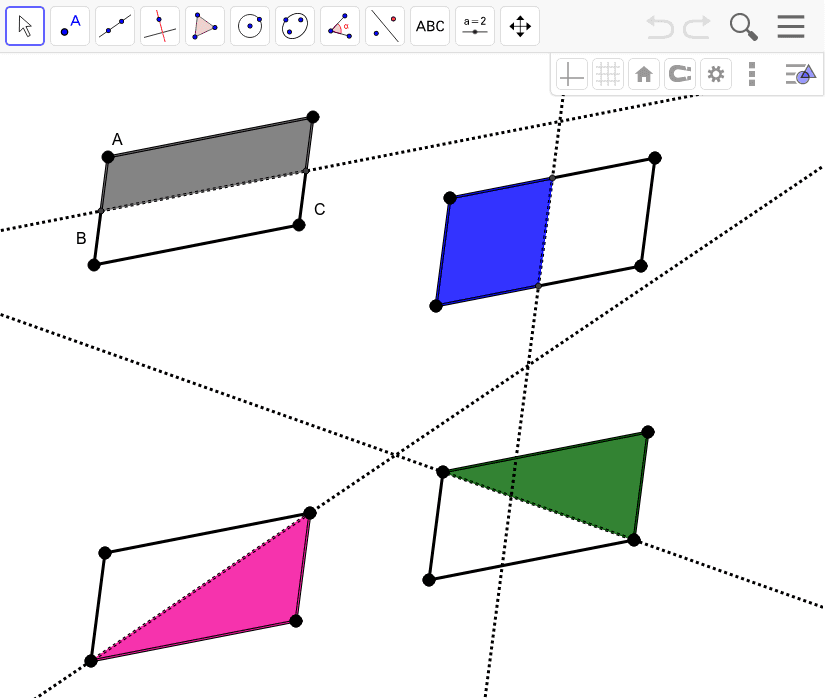
This example demonstrates the reflectional symmetries of a quadrilateral. Key mathematical concepts include reflection transformation and geometric construction. Using GeoGebra commands such as Segment, Line, Intersect, Vector, Translate, Midpoint, and Polygon, the reflection symmetries of a quadrilateral can be constructed. Suitable for middle school and above students to learn about reflection transformations and geometric construction.
GeoGebra Commands & Parameters
Segment(A, B) → fSegment(B, C) → gLine(A, g) → hLine(C, f) → iIntersect(h, i) → DSegment(A, D) → jSegment(D, C) → kVector(E, F) → uVector(G, H) → vVector(I, J) → wTranslate(A, u) → A'Translate(B, u) → B'Segment(A', B') → f'Translate(B, u) → B'_1Translate(C, u) → C'Segment(B'_1, C') → g'Translate(A, u) → A'_1Translate(D, u) → D'Segment(A'_1, D') → j'Translate(D, u) → D'_1Translate(C, u) → C'_1Segment(D'_1, C'_1) → k'Translate(A, v) → A'_2Translate(B, v) → B'_2Segment(A'_2, B'_2) → f'_1Translate(B, v) → B'_3Translate(C, v) → C'_2Segment(B'_3, C'_2) → g'_1Translate(A, v) → A'_3Translate(D, v) → D'_2Segment(A'_3, D'_2) → j'_1Translate(D, v) → D'_3Translate(C, v) → C'_3Segment(D'_3, C'_3) → k'_1Translate(A, w) → A'_4Translate(B, w) → B'_4Segment(A'_4, B'_4) → f'_2Translate(B, w) → B'_5Translate(C, w) → C'_4Segment(B'_5, C'_4) → g'_2Translate(A, w) → A'_5Translate(D, w) → D'_4Segment(A'_5, D'_4) → j'_2Translate(D, w) → D'_5Translate(C, w) → C'_5Segment(D'_5, C'_5) → k'_2Midpoint(B, A) → KMidpoint(D, C) → LMidpoint(A', D') → MMidpoint(B', C') → NLine(K, L) → lLine(M, N) → mLine(B'_4, D'_4) → nLine(A'_2, C'_2) → pPolygon(K, L, D, A) → poly1, k_1, l_1, d, aPolygon(A', B', N, M) → poly2, a', b', n_1, m_1Polygon(A'_2, C'_2, D'_2) → poly3, d'_2, a'_2, c'_2Polygon(B'_4, C'_4, D'_4) → poly4, d'_4, b'_4, c'_4