
Quadrilateral Investigation: What Happens When Both Pairs of Opposite Angles Are
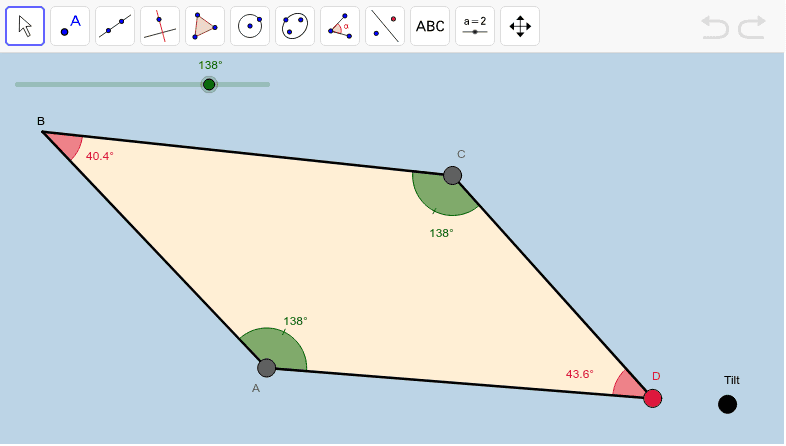
Loading the math board and drawing, please wait…
① This GeoGebra example dynamically explores what happens to a quadrilateral when both pairs of its opposite angles are congruent, guiding students to discover whether such a quadrilateral must be a parallelogram. ② Core mathematical concepts include the angle sum of quadrilaterals, the converse of the parallelogram angle criterion, and the invariance of angle relationships under transformations like rotation. ③ Construction highlights: based on the summary, the construction uses commands such as Rotate, Angle, Ray, Slope, PointIn, Point, Line, Intersect, Segment, and Polygon, with multiple angle objects (α, β, γ, δ, ε) and points (A, B, C, D, A', D') forming polygon poly1; measurements of opposite angles are compared to test the condition. ④ This is suitable for middle school geometry lessons, student-led investigations, or as a template for dynamic geometry worksheets focusing on parallelogram criteria.
GeoGebra Commands & Parameters
Rotate(A_1, α, A) → A'Angle(A_1, A, A') → βRay(A, A_1) → aRay(A, A') → bSlope(a) → cPointIn(e) → CPoint(a) → DLine(A, C) → fRay(C, D) → hRotate(D, (-α), C) → D'Angle(D', C, D) → γRay(C, D') → iIntersect(b, i) → BAngle(A, B, C) → δAngle(C, D, A) → εSegment(C, D) → jSegment(C, B) → kSegment(B, A) → lSegment(A, D) → mSlope(k) → m_1Slope(l) → m_2Slope(j) → m_3Slope(m) → m_4Polygon(A, D, C, B) → poly1, b_1, d_1, c_1, e_1