
Quadrilateral Angles and Geometric Transformations
Loading the math board and drawing, please wait…
In collections
geometriadinamica.es
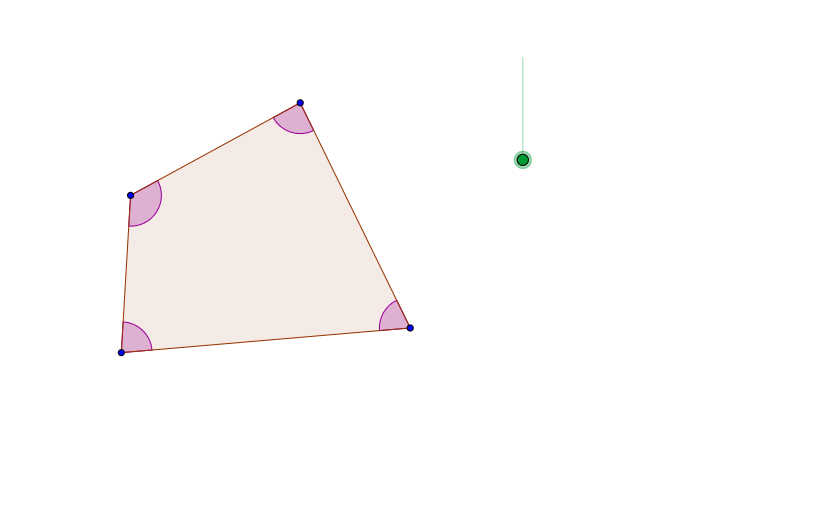
This example demonstrates the measurement of angles in quadrilaterals and their geometric transformations. Key mathematical concepts include angle calculation, similarity transformations, and linear functions. Construction involves GeoGebra commands such as Dilate, Mirror, Polygon, and Angle. Suitable for middle or high school mathematics education to understand geometric transformations and angle properties.
GeoGebra Commands & Parameters
Dilate(C, d, F) → C'Dilate(B, d, F) → B'Mirror(C', B') → KDilate(A, d, F) → A'Polygon(A, B, C, D) → P, a, b, c, eAngle(C, B, A) → ζAngle(D, C, B) → ηAngle(A, D, C) → θAngle(B, A, D) → κAngle((dd * B), (dd * A), (dd * G)) → αAngle((dd * G), (dd * C), (dd * B)) → δAngle((dd * G), (dd * C), (dd * D)) → εAngle((dd * H), (dd * D), (dd * C)) → μAngle((dd * G), (dd * A), (dd * H)) → βSegment(A, G) → fAngle((dd * A), (dd * B), (dd * C)) → ν
AI Drawing Prompt Reference
Draw a quadrilateral, select a point F as center with a scale factor d, dilate one vertex C from F to obtain C', and similarly dilate adjacent vertex B using the same factor to get B'. Mirror C' and B' to create point K. Also dilate vertex A with the same factor to obtain A'. Construct the complete quadrilateral ABCD and measure its four interior angles. Additionally, measure several angles formed by the dilated points with specific points G and H, and draw a line segment connecting vertex A to point G.
The prompt above was compiled from the original drawing commands and is for reference only.