
Quadratic Functions: Standard Form
Loading the math board and drawing, please wait…
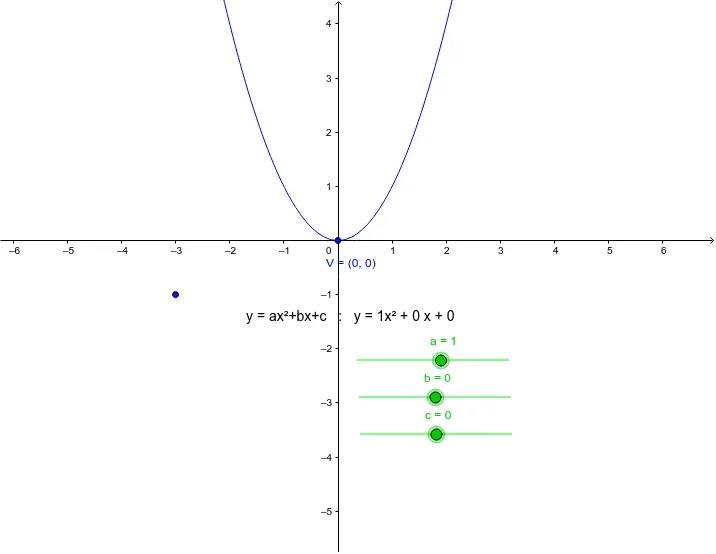
This applet allows students to change the three coefficients in the standard form of a parabola's equation using sliders and observe the changes. It demonstrates the basic properties of quadratic functions, including the vertex, axis of symmetry, and roots. It uses GeoGebra objects such as sliders and function graphs. Suitable for students in middle school and above learning quadratic functions.
GeoGebra Commands & Parameters
Numeric c(0.0)Numeric a(1.0)Numeric b(0.0)f(x) = (a * x^(2)) + (b * x) + c(((-b)) / ((2 * a)), f(((-b)) / ((2 * a))))(0, c)(((-b)) / ((2 * a)) - sqrt(b^(2) - ((4 * a) * c)) / ((2 * a)), 0)(((-b)) / ((2 * a)) + sqrt(b^(2) - ((4 * a) * c)) / ((2 * a)), 0)Point A(-3.0, -1.0)
AI Drawing Prompt Reference
Draw a parabola graph showing how the three coefficients in its standard form affect its shape. Include the parabola itself, the vertex, the axis of symmetry, and the roots. Ensure the graph is clear and these elements adjust accordingly as the coefficients change.
The prompt above was compiled from the original drawing commands and is for reference only.