
Quadratic Function Transformation Example
Loading the math board and drawing, please wait…
In collections
CCGPS AA Unit 6 Lesson 4
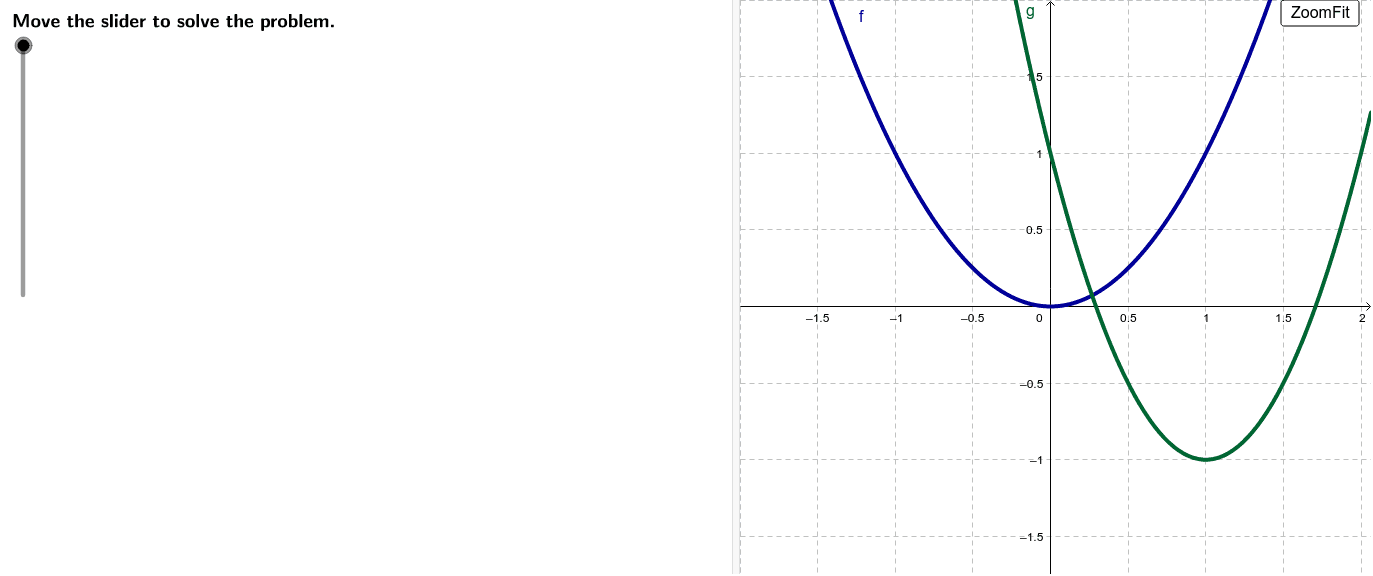
This example demonstrates the graph transformation relationship between the parent function f(x)=x² and its derived functions g(x) and h(x). Core math concepts include quadratic function graphs, translation, and scaling transformations. GeoGebra commands/objects used in construction: LaTeX, Max, If, Extremum, stepMax, stepper, steps, counter, text0, OriginalA, Randomize, ZoomFit, OriginalB, a, h, k, f, g, scale, base, xmin, xmax, ymax, ymin, text10, text11, text13, text14, text16, text19, text20, text22, text23, text15, text27, shiftLR, shiftUD, A, B, text5, text3, text2, text4, text7. Suitable for high school mathematics teaching to understand function graph transformation rules.
GeoGebra Commands & Parameters
LaTeX(steps) → counterLaTeX("\text{Move the slider to solve the problem.}") → text0Max({abs(h), abs(k), abs(g(0))}) → baseLaTeX("\textcolor{#006633}{y=a(x-h)^2+k}") → text10LaTeX((((((("\text{Substitute }\textcolor{#006633}{(" * h) * ",") * k) * ")}\text{ for }\textcolor{#006633}{(h,k)}\text{ and }\textcolor{#006633}{(0,") * g(0)) * ")}\text{ for }\textcolor{#006633}{(x,y)}.")) → text11LaTeX("\text{Simplify.}") → text13LaTeX((((((("\textcolor{#006633}{" * g(0)) * "=") * Simplify[(0 - h)^(2)]) * "a+(") * k) * ")}")) → text14LaTeX((("\textcolor{#006633}{a=" * a) * "}")) → text16LaTeX("\textcolor{#006633}{y=a(x-h)^2+k}") → text19LaTeX((((((("\text{Let }\textcolor{#006633}{y=g(x)}\text{, }\textcolor{#006633}{a=" * a) * "}\text{, and }\textcolor{#006633}{(h,k)=(") * h) * ",") * k) * ")}.")) → text20LaTeX("\text{Simplify.}") → text22LaTeX((("\textcolor{#006633}{g(x)=" * g) * "}")) → text23LaTeX((((("\text{Subtract }\textcolor{#006633}{" * k) * "}\text{ from both sides and divide by }\textcolor{#006633}{") * ((-h))^(2)) * "}.")) → text15LaTeX((("\textcolor{#006633}{g(x)=" * g) * "}")) → text27If(h > 0, "right", "left") → shiftLRIf(k > 0, "up", "down") → shiftUDExtremum(g) → ALaTeX((((("\text{It can be seen from the graph that the vertex of }\textcolor{#006633}{g(x)}\text{ is }\textcolor{#006633}{(" * h) * ", ") * k) * ")}.")) → text5LaTeX("\text{Recall that the vertex of the graph of the quadratic function is also known}\cr\text{as the maximum or minimum point of the function and is represented by the }\cr\text{coordinate }\textcolor{#006633}{(h, k)}\text{. The point }\textcolor{#006633}{(x, y)}\text{ represents some point on the graph}\cr\text{of the function.}") → text3LaTeX("\text{Replace }\textcolor{#006633}{f(x)}\text{ in the equation of the vertex form with }\textcolor{#006633}{y}\text{: }\textcolor{#006633}{y=a(x–h)^2 +k}.") → text2LaTeX("\text{To determine the equation of }\textcolor{#006633}{g(x)}\text{, first identify the vertex of the graph of }\textcolor{#006633}{g(x)}.") → text4LaTeX((("\text{It can be seen from the graph that an additional point on the graph of }\cr\textcolor{#006633}{g(x)}\text{ is }\textcolor{#006633}{(0, " * g(0)) * ")}.")) → text7LaTeX("\text{Next, identify an additional point on the graph of }\textcolor{#006633}{g(x)}.") → text6LaTeX((((((("\text{Use the vertex }\textcolor{#006633}{(" * h) * ", ") * k) * ")}\text{ and the additional point }\textcolor{#006633}{(0, ") * g(0)) * ")}\text{ to find the value of }\textcolor{#006633}{a}\cr\text{in the standard form of the equation.}")) → text8LaTeX("\text{Standard form of a quadratic equation}") → text9LaTeX("\text{Standard form of a quadratic equation}") → text18LaTeX((("\text{The equation of the transformed function }\textcolor{#006633}{g(x)}\text{ in vertex form is }\cr\textcolor{#006633}{g(x)=" * g) * "}.")) → text24LaTeX("\text{Describe the transformation(s) of the parent function that resulted }\cr\text{in the function }\textcolor{#006633}{g(x)}.") → text25LaTeX("\text{To describe the transformation(s) of the parent function }\textcolor{#000099}{f(x) = x^2}\text{, }\cr\text{start inside the parentheses and work outward.}") → text26LaTeX((((("\text{Then, }\textcolor{#006633}{" * a) * "}\text{ was multiplied by the “new” squared term, }\textcolor{#006633}{(") * Simplify[x - h]) * ")^2}.")) → text29If(h ≠ 0, LaTeX[(((("\text{Finally, }\textcolor{#006633}{" * k) * "}\text{ was added to the new squared term with its new }\cr\text{coefficient to give the final result, }\textcolor{#006633}{g(x) = ") * g) * "}.")], LaTeX["\text{No addition was made so the vertex is still on the x-axis.}"]) → text30LaTeX((((((("\textcolor{#006633}{(" * g(0)) * ")=a \left[(0)-(") * h) * ")\right]^2+(") * k) * ")}")) → text12LaTeX("\text{Use the value of }\textcolor{#006633}{a}\text{ and the coordinate of the vertex to write the equation of }\cr\text{the transformed function }\textcolor{#006633}{g(x)}.") → text17LaTeX((((((("\textcolor{#006633}{\left[g(x)\right]=(" * a) * ")\left[x-(") * h) * ")\right]^2+(") * k) * ")}")) → text21If(h ≠ 0, LaTeX[(((((("\text{The value }\textcolor{#006633}{" * h) * "}\text{ was subtracted from }\textcolor{#000099}{x}\text{ to} \text{ shift the vertex ") * shiftLR) * ", which }\cr\text{gives }\textcolor{#006633}{") * Simplify[x - h]) * "}\text{ in place of }\textcolor{#000099}{x}.")], LaTeX["\text{ No change was made in }\textcolor{#000099}{x}\text{ so the function is still centered on the y-axis.}"]) → text28LaTeX("\text{Use the vertex form of a quadratic function, }\textcolor{#006633}{f(x) = a(x – h)^2 + k}\text{, }\cr\text{to determine the equation of the transformed function }\textcolor{#006633}{g(x)}.") → text1LaTeX("\text{Select the Original Problem A button to return to the graph of g(x).}\cr\text{Select the Original Problem B button to explore the graph of h(x).}\cr\text{(Note: Due to functionality, this applet refers to both g(x) and h(x) as g(x).)}\cr\text{Select the New Random Problem button to randomly generate a}\cr\text{similar practice problem.}") → RandomizationText
AI Drawing Prompt Reference
Draw a quadratic function transformation example, including the original function f(x)=x² and its transformed functions g(x) and h(x). First, draw the graph of f(x), then apply transformations to get g(x) and mark its vertex. Next, transform to get h(x) and observe its relationship with g(x). Finally, generate a new random problem to explore the transformation rules.
The prompt above was compiled from the original drawing commands and is for reference only.