
QR4-04-CYU1: Graphing Parabolas in Standard Form Using Vertex Form
Loading the math board and drawing, please wait…
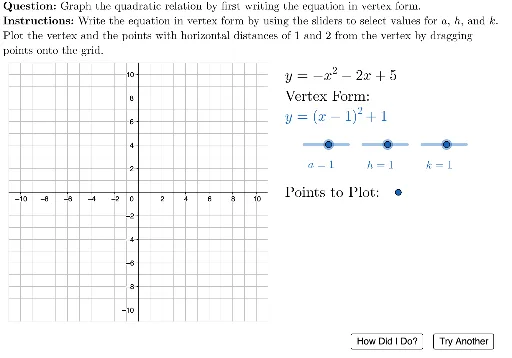
① This interactive GeoGebra example demonstrates how to graph a parabola given in standard form by converting it to vertex form, allowing users to practice identifying the vertex, axis of symmetry, and direction of opening. ② Core mathematical concepts include quadratic functions in standard form (y = ax² + bx + c), vertex form (y = a(x - h)² + k), vertex coordinates, axis of symmetry, and transformations such as translation and scaling. ③ Construction highlights: Based on the construction summary, the example uses GeoGebra commands such as Flatten, Element, Polygon, Point, LaTeX, and FitPoly, along with objects like pointHome, gridSpace, userK, userH, userA, questionList, and TryAnother to generate random questions, capture user inputs, plot points on a grid, check correctness, and provide new problems. ④ This resource is suitable for middle or high school students learning quadratic functions, and can be used for classroom demonstrations or self-paced practice to reinforce the conversion from standard to vertex form and accurate graphing.
GeoGebra Commands & Parameters
Flatten(Sequence[Sequence[(i, j), i, -11, 11, 1], j, -11, 11, 1]) → gridSpaceElement(questionList, questionListIndex) → questionNumElement(C2:C11, questionNum) → correctKElement(B2:B11, questionNum) → correctHElement(A2:A11, questionNum) → correctAElement(O2:O11, questionNum) → correctPointsPolygon({(-11, -11), (-11, 11), (11, 11), (11, -11)}) → viewBoxPoint(Union[gridSpace, {pointHome}]) → DPoint(Union[gridSpace, {pointHome}]) → EPoint(Union[gridSpace, {pointHome}]) → BPoint(Union[gridSpace, {pointHome}]) → CPoint(Union[gridSpace, {pointHome}]) → ALaTeX(UnicodeToLetter[10007]) → xmarkLaTeX(UnicodeToLetter[10003]) → cmarkLaTeX((((("\text{" * QUESTION) * "\\") * INSTRUCTIONS) * "}")) → TEXTFitPoly(correctPoints, 2) → gPolyDottedFitPoly(usersPoints, 2) → gPolySolidLaTeX(standardForm) → standardEquation