
Q3 Math Example by Anthony OR 柯志明
Loading the math board and drawing, please wait…
In collections
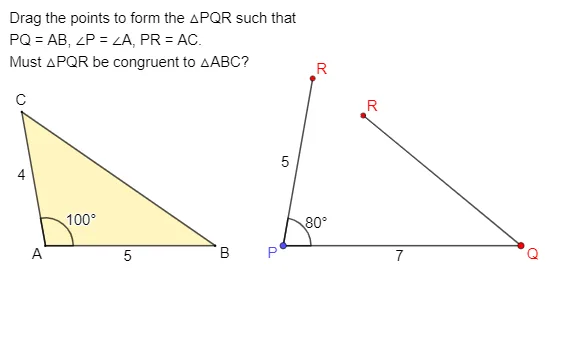
Exploring the Conditions for Congruence of 2 Triangles
Exploring Congruence of Triangles
This example dynamically demonstrates the relationship between geometric shapes and vectors. It involves core mathematical concepts such as vectors, complex numbers, binomial distribution, inequalities, and trapezoids. The construction uses GeoGebra commands and objects like Vector, Sequence, DynamicCoordinates, Point, Rotate, Segment, Polygon, If, and Angle. Suitable for high school students and teachers for teaching demonstrations and explorations.
GeoGebra Commands & Parameters
Vector(A, C1) → uSequence((x(A) + (round(Length[u]) * cos(t°)), y(A) + (round(Length[u]) * sin(t°))), t, 0, 355, 5) → VPointsDynamicCoordinates(C1, x(ClosestPoint[VPoints, C1]), y(ClosestPoint[VPoints, C1])) → CPoint(Sequence[A + (i, 0), i, 1, 20, 1]) → BVector(B, C2) → vRotate(D + (4, 0), 100°, D) → FSegment(F, D) → kSegment(E, F) → jSegment(A, C) → fSegment(A, B) → gDynamicCoordinates(C2, If[Distance[C2, C] < d, x(C), x(C2)], If[Distance[C2, C] < d, y(C), y(C2)]) → C'Sequence(B + (i * UnitVector[Segment[B, C2]]), i, 1, 20, 1) → UPointsSegment(C', B) → hPolygon({A, B, C}) → t1If(Distance[C', C] < d, true, false) → closed1Segment(D, E) → iPolygon(D, E, F) → t3, l, m, nAngle(E, D, F) → αAngle(B, A, C) → β