
Pythagorean Theorem Proof with Diagram
Loading the math board and drawing, please wait…
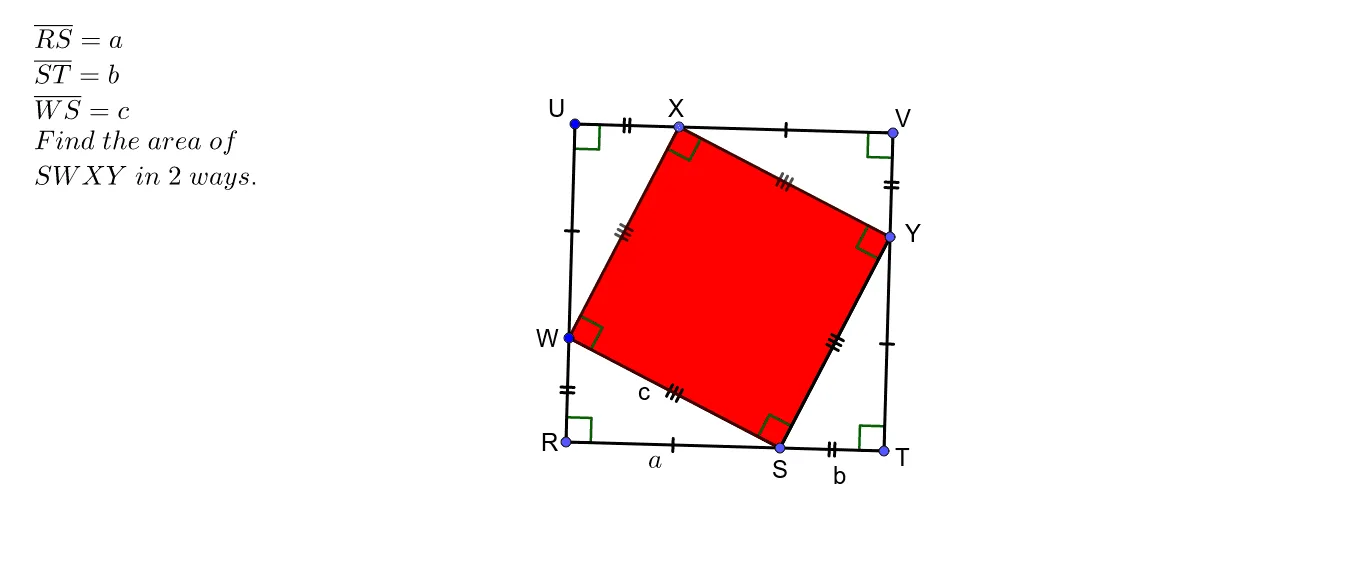
Calculate the area of the red square in two ways to indirectly prove the Pythagorean Theorem. This example involves squares, right triangles, and geometric construction. It uses Segment, OrthogonalLine, Circle, Intersect, Point, Polygon, Angle, etc., GeoGebra commands. Suitable for middle school and above students to learn geometric proofs.
GeoGebra Commands & Parameters
Segment(A, B) → fOrthogonalLine(A, f) → gOrthogonalLine(B, f) → hCircle(A, B) → cCircle(B, A) → dIntersect(d, h, 2) → CIntersect(c, g, 2) → DSegment(C, D) → iSegment(D, A) → jSegment(B, C) → kPoint(j) → ECircle(A, E) → eCircle(B, Radius[e]) → pCircle(C, Radius[p]) → qCircle(D, Radius[q]) → rIntersect(r, i, 1) → FSegment(E, F) → lIntersect(q, k, 1) → GSegment(F, G) → mIntersect(p, f, 1) → HSegment(G, H) → nSegment(H, E) → sPolygon(E, F, G, H) → q1, e_1, f_1, g_1, h_1Polygon(A, H, E) → t1, e_2, a, h_2Polygon(E, D, F) → t2, f_2, e_3, d_1Polygon(F, G, C) → t3, c_1, f_3, g_2Polygon(H, B, G) → t4, g_3, h_3, bPoint(t4) → IPoint(t3) → JPoint(t4) → KAngle(B, A, D) → αAngle(A, D, C) → βAngle(D, C, B) → γAngle(C, B, A) → δAngle(E, H, G) → εAngle(H, G, F) → ζAngle(G, F, E) → ηAngle(F, E, H) → θ