
Pythagorean Theorem in 3D and Real-World Applications
Loading the math board and drawing, please wait…
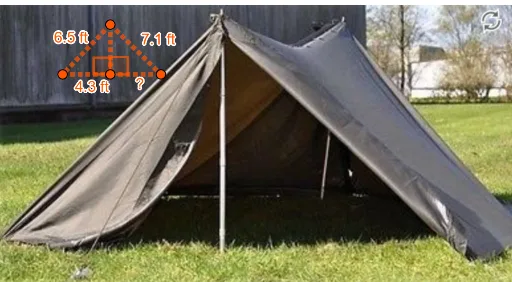
This example demonstrates the application of the Pythagorean Theorem in three-dimensional and real-world scenarios. Core concepts include the Pythagorean Theorem and solid geometry. It is constructed using commands like Line, Point, OrthogonalLine, Segment, and Angle. Suitable for 8th-grade students and learners needing to understand practical applications of the theorem.
GeoGebra Commands & Parameters
Line(C, yAxis) → fPoint(f) → DOrthogonalLine(D, f) → gPoint(g) → ESegment(C, E) → hSegment(E, D) → iSegment(C, D) → jPoint(g) → FSegment(C, F) → kSegment(D, F) → lAngle(E, D, C) → αAngle(C, D, F) → β
AI Drawing Prompt Reference
Create a 3D geometric diagram illustrating the Pythagorean theorem in real-world contexts. Start with a vertical line along an axis, and place a point on it. From that point, draw a line perpendicular to the vertical line, and choose two distinct points on this perpendicular line. Connect the original point to these two points and to another point on the vertical line, forming several right triangles. Finally, mark two angles at the base point on the vertical line, between the vertical line and each slanted segment, to show spatial relationships.
The prompt above was compiled from the original drawing commands and is for reference only.