
Missing Side Lengths in Right Triangles
Loading the math board and drawing, please wait…
In collections
Math 8 Tasks
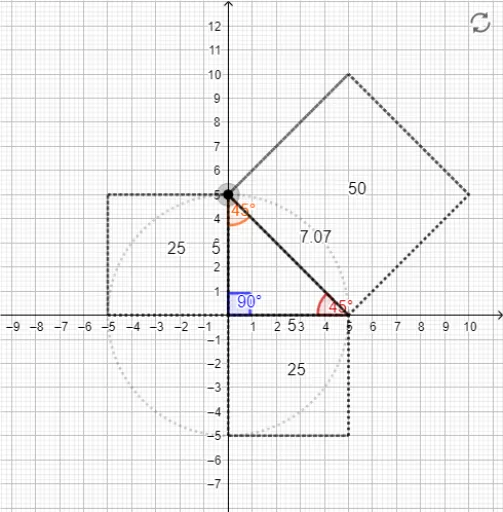
This example demonstrates how to use the Pythagorean Theorem to find missing side lengths of right triangles and determine if a triangle is a right triangle. Key mathematical concepts include the Pythagorean Theorem. Construction highlights include using Intersect, Point, Circle, Polygon, Angle, etc., GeoGebra commands. Suitable for 8th grade math students.
GeoGebra Commands & Parameters
Intersect(xAxis, yAxis) → APoint(yAxis) → BCircle(A, B) → cIntersect(c, xAxis, 2) → CPoint(c) → DPolygon(A, C, D) → t1, d, a, c_1Angle(D, A, C) → αAngle(A, D, C) → βAngle(D, C, A) → γPolygon(A, D, 4) → poly1, f, g, h, i, E, FPolygon(D, C, 4) → poly2, j, k, l, m, G, HPolygon(C, A, 4) → poly3, n, p, q, r, I, J
AI Drawing Prompt Reference
Draw a circle centered at the origin on a coordinate plane. The circle intersects the positive x-axis at one point and the y-axis at another point. Choose an arbitrary point on the circle, then connect it to the x-axis intersection and the origin to form a right triangle. Mark the three interior angles of this triangle. Then, construct squares outward on each of the three sides of the triangle, resulting in three squares total. The final figure shows a right triangle with squares on its sides, illustrating the Pythagorean theorem relationship.
The prompt above was compiled from the original drawing commands and is for reference only.