
Exploring Lengths of Squares and Right Triangles
Loading the math board and drawing, please wait…
In collections
Math 8 Tasks
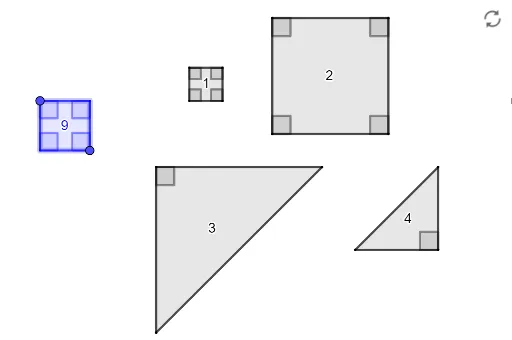
This example demonstrates the relationships between areas and side lengths of squares, right triangles, and composite shapes. Key math concepts include the Pythagorean Theorem, area calculations, and coordinate geometry. It is constructed using commands like Polygon, Line, OrthogonalLine, Intersect, and Angle in GeoGebra. Suitable for middle school mathematics education to help students understand geometric relationships and calculations.
GeoGebra Commands & Parameters
Polygon(H, I, J, K) → q2, h_1, i, j, kPolygon(L, M, N, O) → q3, l_1, m_1, n_1, oPolygon(T, U, V) → t2, v, t, uPolygon(W, Z, C_1) → t3, c_1, w, z_1Line(A_1, B_1) → fOrthogonalLine(A, f) → gOrthogonalLine(B, f) → hLine(A, f) → lLine(B, f) → mIntersect(g, m) → CIntersect(h, l) → DPolygon(A, C, B, D) → q1, a, c, b, dAngle(A, D, B) → αAngle(D, B, C) → βAngle(B, C, A) → γAngle(C, A, D) → δAngle(H, I, J) → εAngle(I, J, K) → ζAngle(J, K, H) → ηAngle(K, H, I) → θAngle(M, N, O) → ιAngle(N, O, L) → κAngle(O, L, M) → λAngle(L, M, N) → μAngle(C_1, Z, W) → σAngle(V, T, U) → τ