
Pythagorean Theorem in Real World
Loading the math board and drawing, please wait…
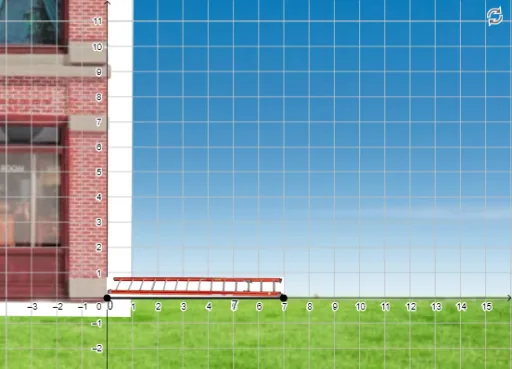
This example demonstrates the application of the Pythagorean Theorem to simple, 2-dimensional, real-world problems. It involves core math concepts like the Pythagorean Theorem and triangles. Constructed using GeoGebra commands/objects such as Point, Line, Intersect, Polygon, and Angle. Suitable for 8th-grade students to learn practical applications of the theorem.
GeoGebra Commands & Parameters
Point(xAxis) → CPoint(xAxis) → DLine(C, D) → fPoint(yAxis) → GPoint(yAxis) → HLine(G, H) → gPoint(g) → IIntersect(f, g) → JPoint(f) → KPolygon(I, J, K) → t1, k, i, jAngle(I, J, K) → α
AI Drawing Prompt Reference
Draw a right triangle with two legs parallel to the coordinate axes, with vertices on the x-axis and y-axis, and the third side as the hypotenuse. First, draw the x-axis and y-axis, then take two points on the x-axis and connect them to form a line. Take two points on the y-axis and connect them to form another line. The intersection of these two lines is the right-angle vertex of the triangle. Finally, connect the right-angle vertex to the point on the x-axis to complete the triangle.
The prompt above was compiled from the original drawing commands and is for reference only.