
Pythagorean Theorem Dynamic GeoGebra Demonstration and Area Proof
Loading the math board and drawing, please wait…
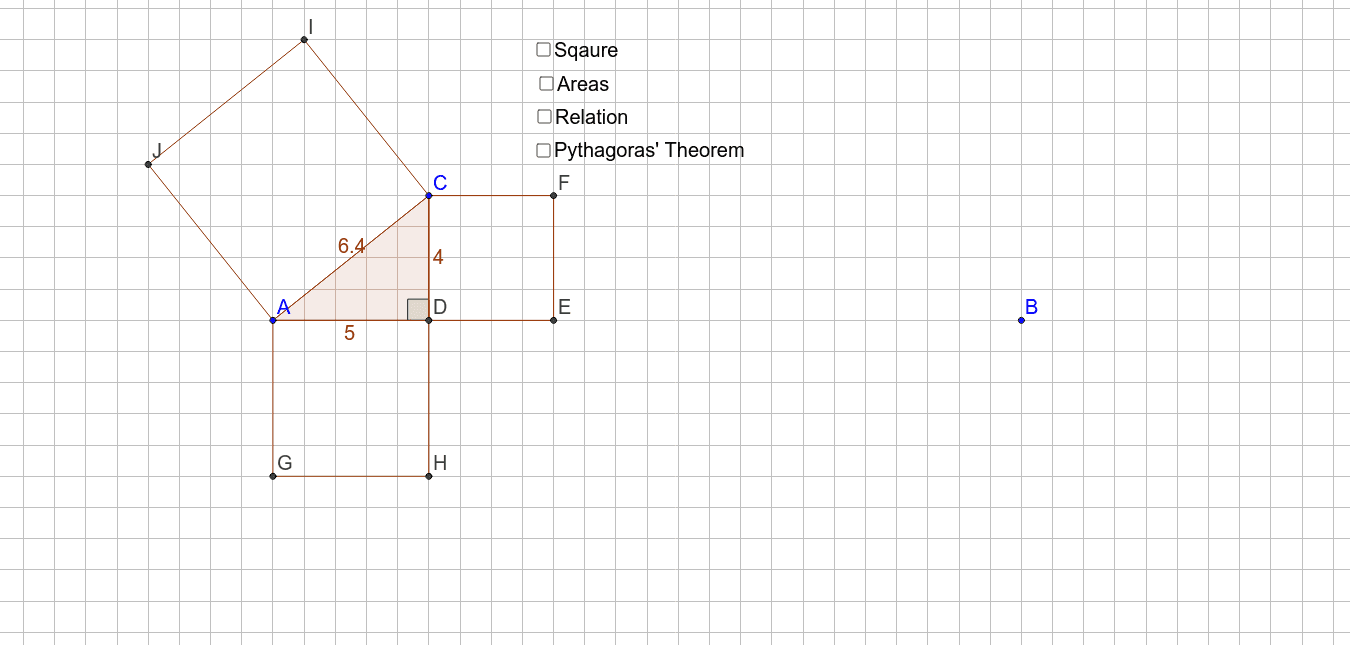
This GeoGebra example dynamically demonstrates the Pythagorean theorem by constructing squares on the three sides of a right triangle and comparing their areas to show a^2 + b^2 = c^2. The core concepts include right triangles, perpendicular lines, segment length, angle measurement, polygon construction, and area relationships. The construction uses Segment to connect points A, B, and C, OrthogonalLine and Intersect to establish the right-angle geometry, Polygon to create squares poly1, poly2, poly3, and poly4, and Angle and Distance to label α, side lengths a, b, c, and area texts such as Textpoly2, Textpoly3, and Textpoly4. It is suitable for middle-school geometry, introductory coordinate geometry, and classroom demonstrations or student explorations of theorem proof.
GeoGebra Commands & Parameters
Segment(A, B) → aOrthogonalLine(C, a) → bIntersect(b, a) → DPolygon(A, C, D) → poly1, d, a_1, cAngle(C, D, A) → αPolygon(C, D, 4) → poly2, e, f, g, h, E, FPolygon(D, A, 4) → poly3, i, j, k, l, G, HPolygon(A, C, 4) → poly4, m, n, p, s, I, JDistance(c, a_1) → o
AI Drawing Prompt Reference
Draw a right triangle with the right angle at the foot of a perpendicular from the hypotenuse. Construct three squares outward on each side of the triangle: two smaller squares on the legs and one larger square on the hypotenuse. Mark the right angle with a symbol, and display the lengths of the three sides and the areas of the three squares. The layout should clearly show that the sum of the areas of the two smaller squares equals the area of the larger square.
The prompt above was compiled from the original drawing commands and is for reference only.