
Pythagorean Theorem Dissection Proof via Translation
Loading the math board and drawing, please wait…
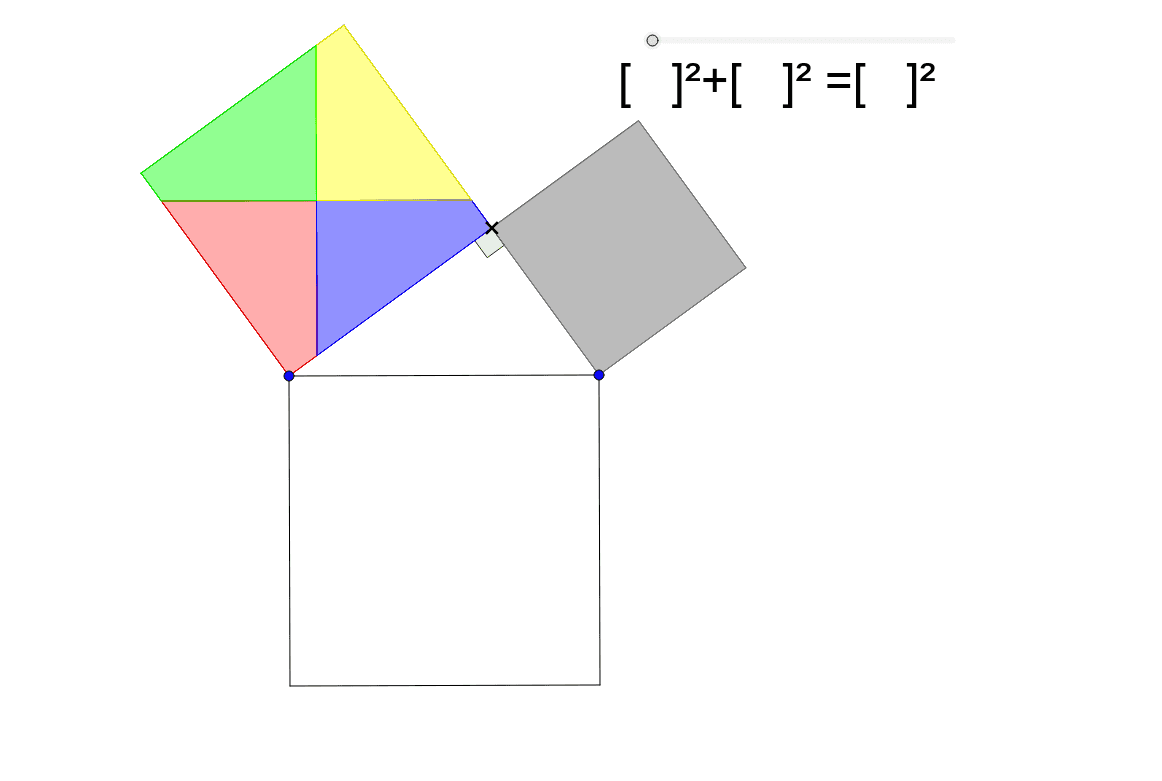
This GeoGebra example demonstrates a dissection proof of the Pythagorean theorem by translating, rotating, and reflecting pieces of a right triangle and related polygons to show that the sum of the squares on the legs equals the square on the hypotenuse. It covers core concepts such as the Pythagorean theorem, area conservation, triangle and polygon dissection, vectors, translation, symmetry, rotation, and geometric invariants. The construction uses Segment, Point, Angle, Polygon, Midpoint, Vector, Translate, Dilate, Circle, Semicircle, Ray, Intersect, and Line to create objects a, b, c, poly2, poly3, and transformed points D', C', E', and B'. It is suitable for middle-school to high-school geometry lessons, mathematical experiments, and GeoGebra-based theorem visualization.
GeoGebra Commands & Parameters
Segment(A, B) → cSemicircle(A, B) → c_2Point(c_2) → CSegment(B, C) → bSegment(C, A) → aAngle(A, C, B) → αPolygon(C, B, 4) → small_1, e, f, g, h, D, EPolygon(A, C, 4) → poly2, i, j, k, l, F, GPolygon(B, A, 4) → poly3, m, n, p, q, H, IMidpoint(D, C) → JMidpoint(F, A) → LMidpoint(I, A) → KVector(J, K) → vTranslate(D, v) → D'Translate(C, v) → C'Translate(E, v) → E'Translate(B, v) → B'Ray(B', D') → rRay(D', E') → sRay(E', C') → tRay(C', B') → a_1Segment(I, H) → b_1Segment(H, A) → c_1Segment(B, I) → d_1Intersect(a_1, b_1) → MIntersect(t, c_1) → NIntersect(r, d_1) → OIntersect(c, s) → PDilate(D', 1 - equals / 100, A) → D''Circle(G, Segment[B', M]) → e_1Segment(F, G) → g_1Segment(A, G) → h_1Segment(C, F) → i_1Intersect(e_1, h_1, 1) → QCircle(A, Segment[G, Q]) → k_1Circle(C, Segment[G, Q]) → q_1Circle(F, Segment[G, Q]) → r_1Intersect(e_1, g_1, 1) → RIntersect(r_1, g_1, 1) → SIntersect(q_1, a, 1) → TIntersect(k_1, a, 1) → UIntersect(k_1, h_1, 1) → VIntersect(q_1, i_1, 1) → WIntersect(r_1, i_1, 1) → ZPolygon(F, W, L, S) → yellow_1, y1A, y1D, y1B, y1CPolygon(S, L, Q, G) → green_1, g1B, g1C, g1D, g1APolygon(L, U, A, Q) → red_1, r1B, r1C, r1D, r1APolygon(U, L, W, C) → blue_1, b1D, b1A, b1B, b1CDilate(D', equals / 100, A) → D''_1Vector(A, D''_1) → v_1Translate(L, v_1) → L'Translate(U, v_1) → U'Translate(A, v_1) → A'Translate(Q, v_1) → Q'Polygon(L', U', A', Q') → red_1', r1B', r1C', r1D', r1A'Dilate(P, equals / 100, W) → P'Vector(W, P') → j_1Translate(U, j_1) → U'_1Translate(L, j_1) → L'_1Translate(W, j_1) → W'Translate(C, j_1) → C'_1Polygon(U'_1, L'_1, W', C'_1) → blue_1', b1D', b1A', b1B', b1C'Dilate(K, equals / 100, J) → K'Vector(J, K') → m_1Translate(small_1, m_1) → small_1'Dilate(H, equals / 100, L) → H'Vector(L, H') → n_1Translate(F, n_1) → F'Translate(W, n_1) → W'_1Translate(L, n_1) → L'_2Translate(S, n_1) → S'Polygon(F', W'_1, L'_2, S') → yellow_1', y1A', y1D_1, y1B_1, y1C_1Dilate(B', equals / 100, G) → B''Vector(G, B'') → wTranslate(S, w) → S'_1Translate(L, w) → L'_3Translate(Q, w) → Q'_1Translate(G, w) → G'Polygon(S'_1, L'_3, Q'_1, G') → green_1', g1B', g1C', g1D', g1A'Dilate(K, equals / 100, L) → K'_1Vector(L, K'_1) → uTranslate(poly2, u) → poly2'Midpoint(A, H) → A_1Midpoint(I, H) → B_1Midpoint(B, I) → C_1Line(C_1, b) → dLine(P, a) → f_1Line(A_1, d) → l_1Line(B_1, f_1) → p_1Intersect(d, f_1) → D_1Intersect(l_1, p_1) → E_1Intersect(f_1, l_1) → F_1Intersect(d, p_1) → G_1Intersect(l_1, b_1) → H_1Circle(E, Segment[C_1, G_1]) → s_1Circle(D, Segment[C_1, G_1]) → t_1Circle(B, Segment[C_1, G_1]) → d_2Circle(C, Segment[C_1, G_1]) → e_2Intersect(b, e) → I_1Intersect(b, e) → J_1Intersect(b, e) → K_1Intersect(d_2, e, 1) → L_1Intersect(d_2, f, 1) → M_1Intersect(e_2, e, 1) → N_1Intersect(e_2, h, 1) → O_1Intersect(s_1, h, 1) → P_1Intersect(s_1, g, 1) → Q_1Intersect(t_1, g, 1) → R_1Intersect(t_1, f, 1) → S_1Polygon(D, S_1, J, Q_1) → yellow_2, y2B, y2C, y2D, y2APolygon(S_1, J, L_1, B) → blue_2, b2A, b2D, b2C, b2BPolygon(L_1, J, O_1, C) → red_2, r2B, r2A, r2D, r2CPolygon(Q_1, E, O_1, J) → green_2, g2A, g2D, g2C, g2BDilate(A, equals / 100, J) → A'_1Vector(J, A'_1) → u_1Dilate(B, equals / 100, J) → B'_1Vector(J, B'_1) → w_1Dilate(H, equals / 100, J) → H'_1Vector(J, H'_1) → u_2Dilate(I, equals / 100, J) → I'Vector(J, I') → v_2Translate(Q_1, v_2) → T_1Translate(E, v_2) → E'_1Translate(O_1, v_2) → U_1Translate(J, v_2) → J'Polygon(T_1, E'_1, U_1, J') → green_2', g2A', g2D', g2C', g2B'Translate(S_1, u_1) → V_1Translate(J, u_1) → J'_1Translate(L_1, u_1) → W_1Translate(B, u_1) → B'_2Polygon(V_1, J'_1, W_1, B'_2) → blue_2', b2A', b2D', b2C', b2B'Translate(L_1, w_1) → Z_1Translate(J, w_1) → J'_2Translate(O_1, w_1) → A_2Translate(C, w_1) → C'_2Polygon(Z_1, J'_2, A_2, C'_2) → red_2', z_1, r2A', r2D', r2C'Translate(D, u_2) → D'_1Translate(S_1, u_2) → B_2Translate(J, u_2) → J'_3Translate(Q_1, u_2) → C_2Polygon(D'_1, B_2, J'_3, C_2) → yellow_2', y2B', y2C', y2D', y2A'
AI Drawing Prompt Reference
Draw a right triangle ABC with AB as the hypotenuse and AC and BC as the legs. Use translation, rotation, and reflection to dissect and reassemble the triangle and related polygons to demonstrate that the sum of the squares of the legs equals the square of the hypotenuse. The steps include constructing the right triangle, creating polygons, translating vectors, rotating, and reflecting points, and ultimately forming four differently colored polygons corresponding to each part of the original triangle.
The prompt above was compiled from the original drawing commands and is for reference only.