
Pythagorean Theorem Animation by hheinrich
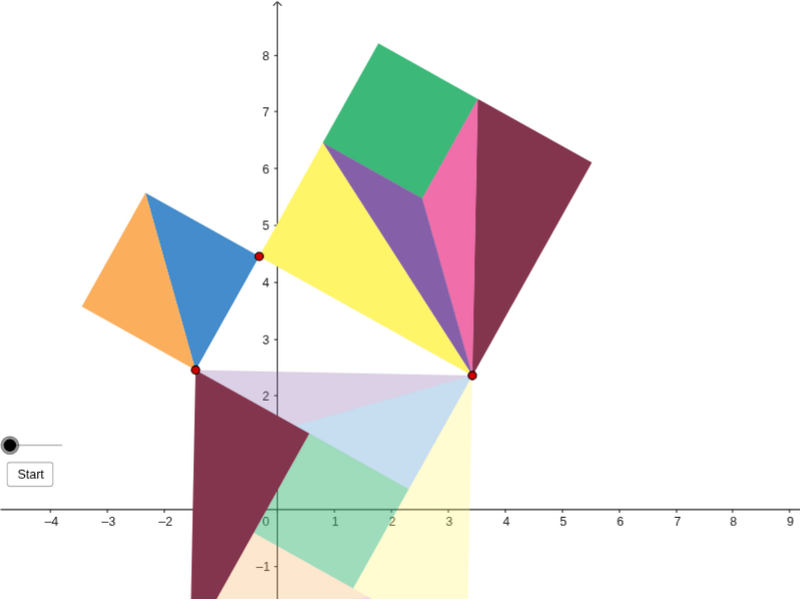
Loading the math board and drawing, please wait…
This example demonstrates the Pythagorean Theorem through animation, illustrating that in a right triangle, the square of the hypotenuse equals the sum of the squares of the other two sides. Key math concepts include right triangles, Pythagorean Theorem, circles, semicircles, rotation, symmetry, etc. The construction involves commands and objects like Semicircle, Intersect, CircleArc, Point, Segment, Mirror, Polygon, OrthogonalLine, Rotate, Midpoint, and If from GeoGebra. Suitable for middle school students and above for learning geometric theorems and for classroom demonstrations.
GeoGebra Commands & Parameters
Semicircle(A4, A5) → cIntersect(c, LineBisector[A4, A5]) → A,CircleArc(Midpoint[A4, A5], A, A4) → r_1Point(r_1) → A6Segment(A6, A5) → bMirror(A4, b) → A12Polygon(A6, A5, 4) → poly2, c_2, b_1, g, h, A9, A10OrthogonalLine(A12, h) → mSegment(A10, A5) → jIntersect(m, j) → A11Rotate(A6, 90*°, A5) → B8Segment(A4, A6) → aSegment(A5, A4) → dPolygon(A4, A6, 4) → poly1, a_1, c_1, e, f, A7, A8Segment(A4, A7) → iMirror(A12, j) → A13Segment(A5, A12) → k_1Segment(A5, A13) → lSegment(A11, A13) → nSegment(A11, A12) → pPolygon(A5, A4, 4) → poly4, b_2, a_2, k, q, B12, B6Rotate(A11, 90*°, A5) → B7Midpoint(A4, B6) → ORotate(B8, 90*°, O) → B10Rotate(B10, 90*°, O) → B11Rotate(B11, 90*°, O) → B13Rotate(B7, 180*°, O) → B9Segment(B13, B8) → rSegment(B8, B10) → sSegment(B11, B13) → d_1Segment(B11, A4) → e_1Segment(B13, B12) → f_1Segment(B8, B6) → g_1Segment(B10, A5) → h_1Segment(B7, A5) → j_1Segment(B9, B12) → p_1Segment(B10, B11) → q_1Polygon(C4, C5, C6, C7) → poly3, c2, c3, c4, c5Polygon(D4, D5, D6) → poly5, d4, d2, d3Polygon(E4, E5, E6) → poly6, e4, e2, e3Polygon(F4, F5, F6) → poly7, f4, f2, f3Polygon(G4, G5, G6) → poly8, g4, g2, g3Polygon(H4, H5, H6) → poly9, h4, h2, h3Polygon(I4, I5, I6) → poly10, i4, i2, i3If(time < C$2, C4, If[(C$2 ≤ time) ∧ (time < C$3), C4 - (time - C$2) * (C4 - C9) / (C$3 - C$2), C9]) → J4If(time < C$2, C5, If[(C$2 ≤ time) ∧ (time < C$3), C5 - (time - C$2) * (C5 - C10) / (C$3 - C$2), C10]) → J5If(time < C$2, C6, If[(C$2 ≤ time) ∧ (time < C$3), C6 - (time - C$2) * (C6 - C11) / (C$3 - C$2), C11]) → J6If(time < C$2, C7, If[(C$2 ≤ time) ∧ (time < C$3), C7 - (time - C$2) * (C7 - C12) / (C$3 - C$2), C12]) → J7If(time < D$2, D4, If[(D$2 ≤ time) ∧ (time < D$3), D4 - (time - D$2) * (D4 - D9) / (D$3 - D$2), D9]) → K4If(time < D$2, D5, If[(D$2 ≤ time) ∧ (time < D$3), D5 - (time - D$2) * (D5 - D10) / (D$3 - D$2), D10]) → K5If(time < D$2, D6, If[(D$2 ≤ time) ∧ (time < D$3), D6 - (time - D$2) * (D6 - D11) / (D$3 - D$2), D11]) → K6If(time < E$2, E4, If[(E$2 ≤ time) ∧ (time < E$3), E4 - (time - E$2) * (E4 - E9) / (E$3 - E$2), E9]) → L4If(time < E$2, E5, If[(E$2 ≤ time) ∧ (time < E$3), E5 - (time - E$2) * (E5 - E10) / (E$3 - E$2), E10]) → L5If(time < E$2, E6, If[(E$2 ≤ time) ∧ (time < E$3), E6 - (time - E$2) * (E6 - E11) / (E$3 - E$2), E11]) → L6If(time < F$2, F4, If[(F$2 ≤ time) ∧ (time < F$3), F4 - (time - F$2) * (F4 - F9) / (F$3 - F$2), F9]) → M4If(time < F$2, F5, If[(F$2 ≤ time) ∧ (time < F$3), F5 - (time - F$2) * (F5 - F10) / (F$3 - F$2), F10]) → M5If(time < F$2, F6, If[(F$2 ≤ time) ∧ (time < F$3), F6 - (time - F$2) * (F6 - F11) / (F$3 - F$2), F11]) → M6If(time < G$2, G4, If[(G$2 ≤ time) ∧ (time < G$3), G4 - (time - G$2) * (G4 - G9) / (G$3 - G$2), G9]) → N4If(time < G$2, G5, If[(G$2 ≤ time) ∧ (time < G$3), G5 - (time - G$2) * (G5 - G10) / (G$3 - G$2), G10]) → N5If(time < G$2, G6, If[(G$2 ≤ time) ∧ (time < G$3), G6 - (time - G$2) * (G6 - G11) / (G$3 - G$2), G11]) → N6If(time < H$2, H4, If[(H$2 ≤ time) ∧ (time < H$3), H4 - (time - H$2) * (H4 - H9) / (H$3 - H$2), H9]) → O4If(time < H$2, H5, If[(H$2 ≤ time) ∧ (time < H$3), H5 - (time - H$2) * (H5 - H10) / (H$3 - H$2), H10]) → O5If(time < H$2, H6, If[(H$2 ≤ time) ∧ (time < H$3), H6 - (time - H$2) * (H6 - H11) / (H$3 - H$2), H11]) → O6If(time < I$2, I4, If[(I$2 ≤ time) ∧ (time < I$3), I4 - (time - I$2) * (I4 - I9) / (I$3 - I$2), I9]) → P4If(time < I$2, I5, If[(I$2 ≤ time) ∧ (time < I$3), I5 - (time - I$2) * (I5 - I10) / (I$3 - I$2), I10]) → P5If(time < I$2, I6, If[(I$2 ≤ time) ∧ (time < I$3), I6 - (time - I$2) * (I6 - I11) / (I$3 - I$2), I11]) → P6Polygon(J4, J5, J6, J7) → poly11, j4, j5, j6, j7Polygon(K4, K5, K6) → poly12, k6, k4, k5Polygon(L4, L5, L6) → poly13, l6, l4, l5Polygon(M4, M5, M6) → poly14, m6, m4, m5Polygon(N4, N5, N6) → poly15, n6, n4, n5Polygon(O4, O5, O6) → poly16, o6, o4, o5Polygon(P4, P5, P6) → poly17, p6, p4, p5Polygon(C9, C10, C11, C12) → poly18, c9, c10, c11, c12Polygon(D9, D10, D11) → poly19, d11, d9, d10Polygon(E9, E10, E11) → poly20, e11, e9, e10Polygon(F9, F10, F11) → poly21, f11, f9, f10Polygon(G9, G10, G11) → poly22, g11, g9, g10Polygon(H9, H10, H11) → poly23, h11, h9, h10Polygon(I9, I10, I11) → poly24, i11, i9, i10
AI Drawing Prompt Reference
Draw a right triangle with two semicircles representing the squares of the legs and a third semicircle for the hypotenuse, demonstrating the Pythagorean theorem through animation. Include rotation and symmetry elements.
The prompt above was compiled from the original drawing commands and is for reference only.