
Pythagorean Rectangular Prism Model
Loading the math board and drawing, please wait…
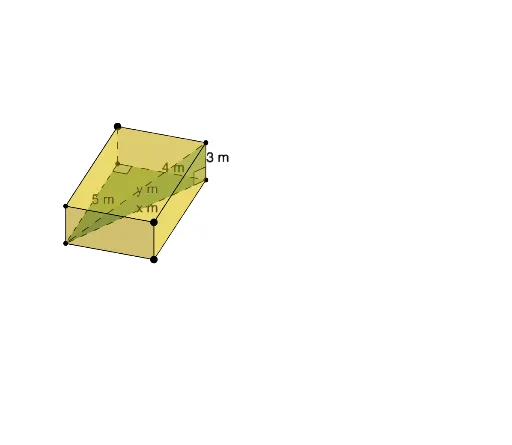
This example demonstrates the Pythagorean theorem in a rectangular prism by constructing its diagonals and faces, visually showcasing spatial geometric relationships. Core mathematical concepts include the Pythagorean theorem, solid geometry, spatial vectors, and linear programming. Construction highlights the use of GeoGebra commands/objects like Intersect, Point, Segment, Line, OrthogonalLine, Prism, Polygon, and Angle. Suitable for high school teaching and learning in solid geometry and spatial vectors.
GeoGebra Commands & Parameters
Intersect(yAxis, zAxis) → APoint(yAxis) → BPoint(xAxis) → CSegment(A, B) → fSegment(A, C) → gLine(C, yAxis) → hLine(B, xAxis) → iIntersect(i, h) → DSegment(D, B) → jSegment(D, C) → kOrthogonalLine(B, xOyPlane) → lPoint(l) → EPrism(B, A, C, D, E) → a, F, edgeAB, edgeAC, edgeCD, edgeBD, edgeBE, edgeAF, edgeCG, edgeDH, edgeEF, edgeFG, G, edgeGH, edgeEH, H, faceABDC, faceABEF, faceACGF, faceCDHG, faceBDHE, faceEFGHSegment(A, D) → nSegment(D, F) → mPolygon(C, A, D) → t1, d, c, a_1Polygon(A, F, D) → t2, d_1, a_2, f_1Angle(D, C, A) → αAngle(F, A, D) → β
AI Drawing Prompt Reference
Draw a rectangular prism and showcase its spatial geometric relationships. Start by plotting the three coordinate axes and identifying their intersections and points on each axis. Connect these points to form the edges and faces of the prism, and draw the diagonals. Pay special attention to the relationships between the diagonals and the faces, and how these elements visually demonstrate the Pythagorean theorem. The final image should include all edges, faces, and diagonals of the prism, along with relevant angles and spatial vector relationships.
The prompt above was compiled from the original drawing commands and is for reference only.