
Pythagoras' Theorem Proof
Loading the math board and drawing, please wait…
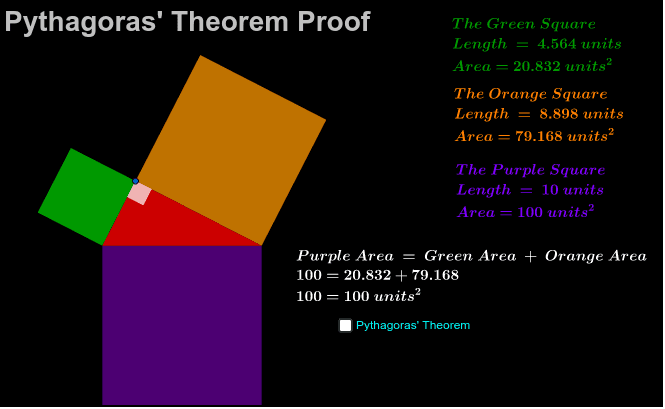
This example visually demonstrates Pythagoras' Theorem using geometric shapes, specifically focusing on the relationship between the sides of a right-angled triangle. It constructs polygons, semicircles, and points to show that the square of the hypotenuse is equal to the sum of the squares of the other two sides. Commands used include Polygon, Semicircle, Point, and others, suitable for middle school and above students learning geometric proofs.
GeoGebra Commands & Parameters
Polygon(A, B, 4) → poly1, a, b, c, d, C, DSemicircle(B, A) → ePoint(e) → EPolygon(B, E, 4) → poly2, b_1, e_1, f, g, F, GPolygon(E, A, 4) → poly3, e_2, a_1, h, i, H, IPolygon(B, E, A) → poly4, a_2, b_2, e_3Angle(B, E, A) → αDistance(F, E) → distanceFEDistance(I, H) → distanceIHDistance(B, A) → distanceBA
AI Drawing Prompt Reference
Draw a right triangle ABC with B as the right angle. Draw a semicircle with B as the center and BA as the radius. Choose any point E on the semicircle. Construct isosceles triangles BEF and BEI with E as the apex and sides BE. Connect BF and EI to demonstrate that the square of the hypotenuse in a right triangle is equal to the sum of the squares of the other two sides.
The prompt above was compiled from the original drawing commands and is for reference only.