
Pythagoras Puzzle Discovery
Loading the math board and drawing, please wait…
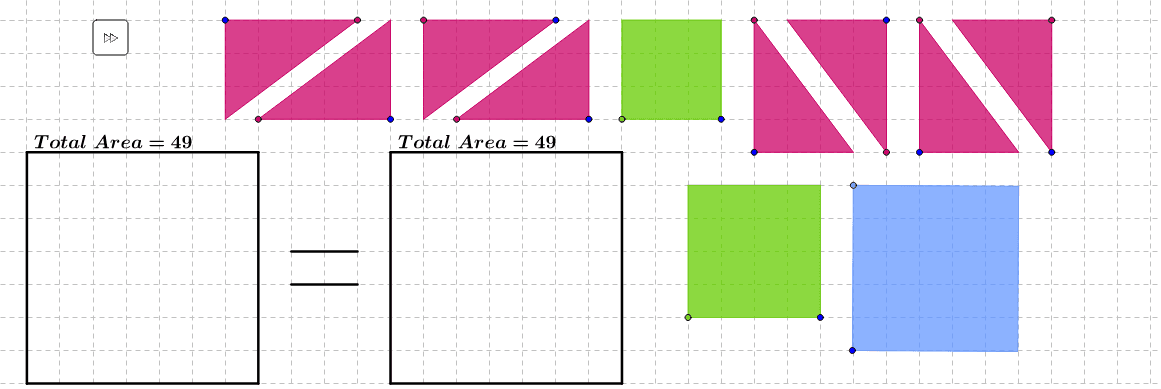
This example demonstrates how students can independently discover Pythagoras' theorem through interactive geometric constructions. It involves core concepts like Pythagorean theorem, right triangles, and area calculations. The construction uses commands such as Point, Polygon, Segment, Area, and PointIn. Suitable for middle school and above to understand the geometric meaning and verify the theorem's generality.
GeoGebra Commands & Parameters
Point(Circle[A_1, 7]) → A_2Polygon(A_1, A_2, A_3, A_4) → poly1, a_1, a_2, a_3, a_4Point(Circle[B_1, 7]) → B_2Polygon(B_1, B_2, B_3, B_4) → poly2, b_1, b_2, b_3, b_4Segment(E_1, E_2) → aSegment(E_3, E_4) → bArea(poly1) → sArea(poly2) → tPointIn(poly1) → EPointIn(poly2) → FPoint(Circle[A, 4]) → BPolygon(A, B, C) → poly3, c_1, a_5, b_5Point(Circle[D, 4]) → GPolygon(D, G, H) → poly4, h, d, gPoint(Circle[I, 4]) → JPolygon(I, J, K) → poly5, k, i, jPoint(Circle[L, 4]) → MPolygon(L, M, N) → poly6, n, l, mPoint(Circle[O, 4]) → PPolygon(O, P, Q) → poly7, q, o, pPoint(Circle[R, 4]) → SPolygon(R, S, T) → poly8, t_1, r, s_1Point(Circle[U, 4]) → VPolygon(U, V, W) → poly9, w, u, vPoint(Circle[Z, 4]) → C_1Polygon(Z, C_1, D_1) → poly10, d_1, z, c_2Point(Circle[F_1, 3]) → G_1Polygon(F_1, G_1, H_1, I_1) → poly11, f_1, g_1, h_1, i_1Point(Circle[J_1, 4]) → K_1Polygon(J_1, K_1, L_1, M_1) → poly12, j_1, k_1, l_1, m_1Point(Circle[N_1, 5]) → O_1Polygon(N_1, O_1, P_1, Q_1) → poly13, n_1, o_1, p_1, q_1Area(poly13) → bluePoint(Circle[R_1, 3]) → S_1Polygon(R_1, S_1, T_1) → poly14, t_2, r_1, s_2Point(Circle[U_1, 4]) → V_1Polygon(U_1, V_1, W_1, Z_1) → poly15, u_1, v_1, w_1, z_1Point(Circle[C_2, 3]) → D_2Polygon(C_2, D_2, F_2, G_2) → poly16, c_3, d_2, f_2, g_2Point(Circle[H_2, 5]) → I_2Polygon(H_2, I_2, J_2, K_2) → poly17, h_2, i_2, j_2, k_2
AI Drawing Prompt Reference
Draw a geometric diagram to demonstrate the discovery of Pythagoras' theorem. Include two large triangles and multiple small triangles, verifying the theorem by calculating areas. Start by drawing two large triangles, then construct several small triangles inside them, labeling the areas. Finally, compare the sum of the areas of the large triangles with the sum of the areas of the small triangles to visually demonstrate the theorem.
The prompt above was compiled from the original drawing commands and is for reference only.