
Pythagoras Cylinder
Loading the math board and drawing, please wait…
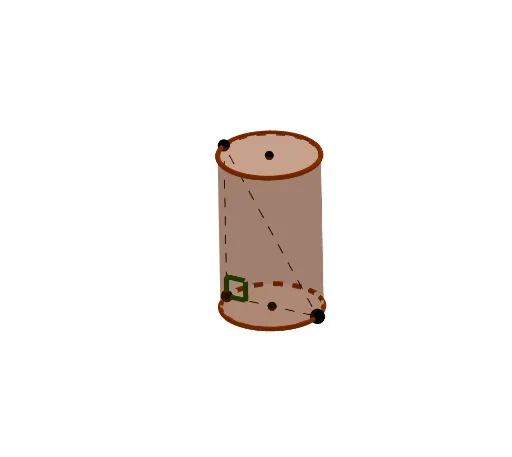
This example demonstrates the geometric construction and properties of the Pythagoras Cylinder. It involves core mathematical concepts such as solid geometry, coordinate geometry, and angle calculations. The construction utilizes GeoGebra commands and objects like Cylinder, Point, Ray, Intersect, OrthogonalLine, Segment, and Angle as outlined in the construction summary. It is suitable for high school and above students learning about the construction of solid geometric figures and related mathematical concepts.
GeoGebra Commands & Parameters
Cylinder(A, B, 3) → a, c, d, bPoint(d) → CRay(C, B) → fIntersect(f, d, 1) → DOrthogonalLine(D, d) → gIntersect(g, c, 1) → ESegment(C, E) → hSegment(E, D) → iSegment(D, C) → jAngle(C, D, E) → α
AI Drawing Prompt Reference
Draw a cylinder with point C as the center, a base radius of 3, and a height equal to the length of line segment BC. Then, draw a ray from point C to point B, which intersects the base of the cylinder at point D. Next, draw a perpendicular line from point D, which intersects the side of the cylinder at point E. Finally, connect points C, E, and D to form a triangle and measure the angle CED.
The prompt above was compiled from the original drawing commands and is for reference only.