
Pyramid/Prism Volume
Loading the math board and drawing, please wait…
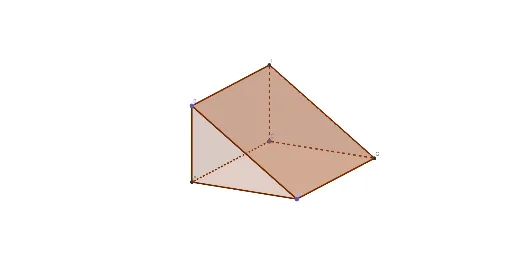
This example demonstrates how to calculate the volume of a pyramid and prism using geometric construction. Key mathematical concepts include volume calculations in solid geometry. Using GeoGebra commands such as Intersect, Point, and Polygon, various faces and edges of the pyramid and prism are constructed. Suitable for middle school and above students or teachers to understand basic concepts of solid geometry.
GeoGebra Commands & Parameters
Intersect(xAxis, yAxis) → APoint(zAxis) → BPoint(xAxis) → CPoint(yAxis) → DPolygon(F, G, C) → t3, c_2, f, gPolygon(B, A, D) → t1, d, b, aPyramid(t1, C) → c, faceABC, faceACD, faceBCD_1, edgeBC, edgeAC, edgeCD_1Pyramid(t3, D) → e, faceDFG, faceCDG, faceCDF_1, edgeDF_1, edgeDG, edgeCD_2Polygon(B, F, C) → t2, c_1, b_1, f_1Pyramid(t2, D) → h, faceBDF, faceCDF, faceBCD, edgeBD, edgeDF, edgeCDPrism(t1, F) → l, E, edgeEF, edgeEH, edgeFH, H, faceABFE, faceADHE, faceBDHF, faceEFH, edgeBF, edgeAE, edgeDHIf(i ≟ true, false, If[j ≟ true, false, If[k ≟ true, false, true]]) → m
AI Drawing Prompt Reference
Draw a pyramid and a prism. Start by creating a 3D coordinate system, then take points on the x-axis, y-axis, and z-axis to form the base and sides of the pyramid and prism. Ensure all faces and edges are correctly connected to form a complete geometric shape.
The prompt above was compiled from the original drawing commands and is for reference only.