
Pyramid Construction and Geometry Demo by rowanw
Loading the math board and drawing, please wait…
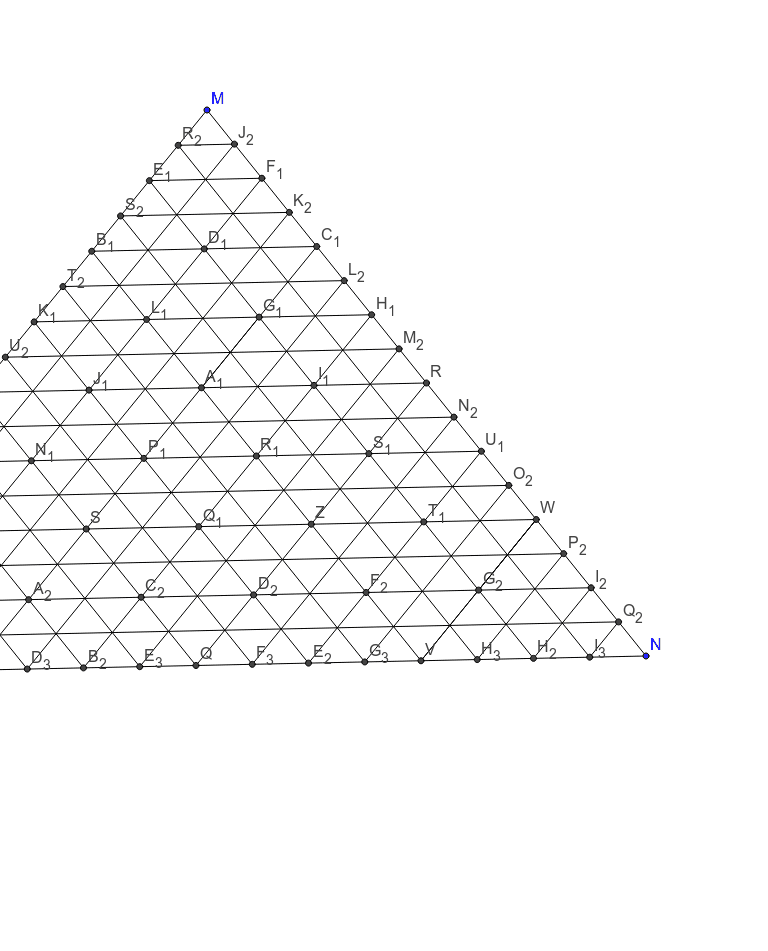
This example dynamically demonstrates the geometric construction and properties of pyramids using GeoGebra. It involves core math concepts like area calculation, exponential functions, distributions, statistical characteristics, and linear programming. Construction highlights include commands like Circle, Intersect, Point, Segment, and Midpoint. Suitable for high school and above learners for understanding solid geometry and optimization problems.
GeoGebra Commands & Parameters
Circle(A, B) → cCircle(B, C) → dCircle(C, A) → eCircle(C, B) → fCircle(C, D) → gIntersect(c, e, 1) → ECircle(C, E) → hCircle(C, F) → kPoint(c) → GCircle(C, G) → pPoint(d) → HCircle(C, H) → qPoint(q) → ICircle(C, I) → rCircle(C, G) → sCircle(C, I) → tCircle(C, J) → c_1Point(c_1) → KCircle(C, K) → d_1Circle(C, L) → e_1Segment(M, N) → aSegment(O, N) → bSegment(M, O) → iMidpoint(i) → PMidpoint(b) → QMidpoint(a) → RSegment(P, Q) → jSegment(R, Q) → lSegment(R, P) → mMidpoint(j) → SMidpoint(P, O) → TMidpoint(Q, O) → UMidpoint(Q, N) → VMidpoint(R, N) → WMidpoint(R, Q) → ZMidpoint(R, P) → A_1Midpoint(P, M) → B_1Midpoint(R, M) → C_1Segment(B_1, A_1) → nSegment(C_1, A_1) → a_1Segment(B_1, C_1) → b_1Segment(A_1, S) → f_1Segment(Z, A_1) → g_1Segment(S, Z) → h_1Segment(Z, V) → i_1Segment(Z, W) → j_1Segment(W, V) → k_1Segment(S, U) → l_1Segment(S, T) → m_1Segment(U, T) → n_1Midpoint(C_1, B_1) → D_1Midpoint(M, B_1) → E_1Midpoint(M, C_1) → F_1Midpoint(C_1, A_1) → G_1Midpoint(C_1, R) → H_1Midpoint(A_1, R) → I_1Midpoint(A_1, P) → J_1Midpoint(P, B_1) → K_1Midpoint(A_1, B_1) → L_1Midpoint(T, P) → M_1Midpoint(S, P) → N_1Midpoint(T, S) → O_1Midpoint(S, A_1) → P_1Midpoint(S, Z) → Q_1Midpoint(A_1, Z) → R_1Midpoint(Z, R) → S_1Midpoint(Z, W) → T_1Midpoint(W, R) → U_1Midpoint(T, U) → V_1Midpoint(O, U) → W_1Midpoint(O, T) → Z_1Midpoint(U, S) → A_2Midpoint(U, Q) → B_2Midpoint(S, Q) → C_2Midpoint(Q, Z) → D_2Midpoint(Q, V) → E_2Midpoint(Z, V) → F_2Midpoint(V, W) → G_2Midpoint(V, N) → H_2Midpoint(W, N) → I_2Segment(E_1, F_1) → p_1Segment(D_1, F_1) → q_1Segment(E_1, D_1) → r_1Segment(L_1, D_1) → s_1Segment(G_1, D_1) → t_1Segment(L_1, G_1) → a_2Segment(A_1, G_1) → b_2Segment(I_1, G_1) → c_2Segment(G_1, H_1) → d_2Segment(I_1, H_1) → e_2Segment(J_1, L_1) → f_2Segment(K_1, L_1) → g_2Segment(J_1, K_1) → h_2Segment(N_1, J_1) → i_2Segment(P_1, J_1) → j_2Segment(R_1, I_1) → k_2Segment(S_1, I_1) → l_2Segment(R_1, S_1) → m_2Segment(S_1, U_1) → n_2Segment(U_1, E_2) → p_2Segment(W, V) → q_2Segment(H_2, I_2) → r_2Segment(G_2, S_1) → s_2Segment(H_2, G_2) → t_2Segment(W, G_2) → a_3Segment(G_2, I_2) → b_3Segment(Z_1, G_2) → c_3Segment(M_1, B_2) → d_3Segment(R_1, B_2) → e_3Segment(N_1, W_1) → f_3Segment(M_1, R_1) → g_3Segment(P_1, E_2) → h_3Segment(Z_1, W_1) → i_3Midpoint(M, F_1) → J_2Midpoint(F_1, C_1) → K_2Midpoint(C_1, H_1) → L_2Midpoint(H_1, R) → M_2Midpoint(R, U_1) → N_2Midpoint(U_1, W) → O_2Midpoint(W, I_2) → P_2Midpoint(I_2, N) → Q_2Midpoint(M, E_1) → R_2Midpoint(E_1, B_1) → S_2Midpoint(B_1, K_1) → T_2Midpoint(K_1, P) → U_2Midpoint(P, M_1) → V_2Midpoint(M_1, T) → W_2Midpoint(T, Z_1) → Z_2Midpoint(Z_1, O) → A_3Midpoint(O, W_1) → B_3Midpoint(W_1, U) → C_3Midpoint(U, B_2) → D_3Midpoint(B_2, Q) → E_3Midpoint(Q, E_2) → F_3Midpoint(E_2, V) → G_3Midpoint(V, H_2) → H_3Midpoint(H_2, N) → I_3Segment(R_2, I_3) → j_3Segment(J_2, B_3) → k_3Segment(K_2, C_3) → l_3Segment(L_2, D_3) → m_3Segment(M_2, E_3) → n_3Segment(N_2, F_3) → p_3Segment(O_2, G_3) → q_3Segment(P_2, H_3) → r_3Segment(Q_2, I_3) → s_3Segment(S_2, H_3) → t_3Segment(T_2, G_3) → a_4Segment(U_2, F_3) → b_4Segment(V_2, E_3) → c_4Segment(W_2, D_3) → d_4Segment(Z_2, C_3) → e_4Segment(A_3, B_3) → f_4Segment(S_2, K_2) → g_4Segment(T_2, L_2) → h_4Segment(U_2, M_2) → i_4Segment(V_2, N_2) → j_4Segment(W_2, O_2) → k_4Segment(Z_2, P_2) → l_4Segment(A_3, Q_2) → m_4Segment(R_2, J_2) → n_4