
Protractor Angle Measurement
Loading the math board and drawing, please wait…
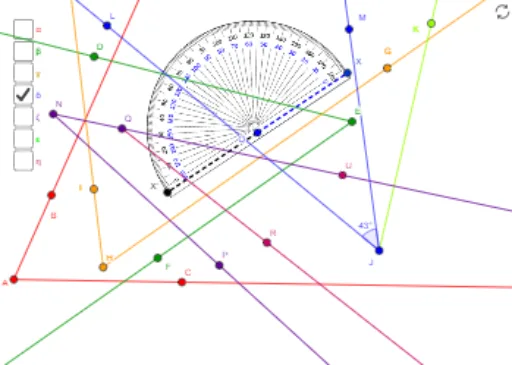
This example demonstrates how to measure angles using a protractor. It involves core mathematical concepts such as angle measurement and geometric construction. Key GeoGebra commands/objects used include Point, Segment, Mirror, Semicircle, OrthogonalLine, Circle, Intersect, Ray, and Angle. Suitable for middle school students and above learning geometric constructions and angle measurement techniques.
GeoGebra Commands & Parameters
Point(Circle[O, 7]) → XSegment(O, X) → qMirror(X, O) → X'Segment(O, X') → rSemicircle(X', X) → eOrthogonalLine(X, q) → iOrthogonalLine(O, q) → jCircle(X, 0.4) → sCircle(O, 0.4) → tCircle(X', 0.4) → c_1OrthogonalLine(X', r) → aIntersect(s, i) → B1, D1_1Intersect(t, j) → E1, K1Intersect(c_1, a) → L1, F1Ray(A, B) → fRay(A, C) → gAngle(g, f) → αRay(E, D) → hRay(E, F) → kAngle(h, k) → βRay(H, G) → lRay(H, I) → mAngle(l, m) → γRay(J, K) → nRay(J, L) → pRay(J, M) → dAngle(d, p) → δAngle(n, d) → εRay(N, U) → f_1Ray(N, P) → g_1Point(f_1) → QRay(Q, R) → h_1Angle(g_1, f_1) → ζAngle(h_1, f_1) → η