
Limits at Infinity of Rational Functions
Loading the math board and drawing, please wait…
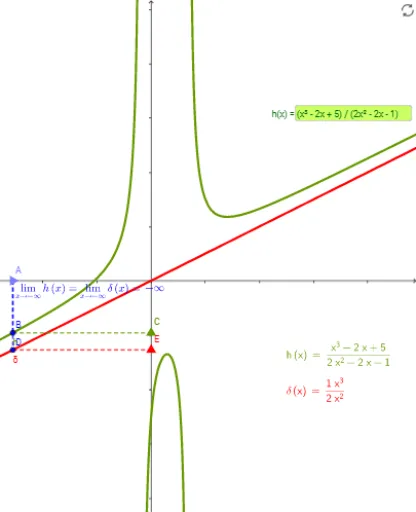
This example explores the limits at infinity of rational functions. The key math concept is that the limit of a rational function at infinity is equal to the ratio of the coefficients of the highest degree terms. Construction highlights include using GeoGebra commands/objects like Textfield, Numerator, Denominator, Degree, Coefficients, LaTeX, Point, Intersect, Segment. Ideal for high school and above students learning about limits and function analysis.
GeoGebra Commands & Parameters
Textfield(h) → InputBox1Numerator(h) → fDenominator(h) → gDegree(f) → nDegree(g) → mCoefficients(f) → L_1Coefficients(g) → L_2LaTeX(δ, true, true) → text1LaTeX(h, true, true) → text2LaTeX(Limit[δ, Infinity], true) → text6LaTeX(Limit[h, -Infinity], true) → text4Point(xAxis) → AIntersect(h, i, (-5.109957107146898, -1.9238822949308398)) → BIntersect(j, yAxis) → CSegment(A, B) → kSegment(B, C) → lIntersect(δ, i, (-5.109957107146898, -2.554978553573449)) → DIntersect(p, yAxis) → ESegment(D, E) → qSegment(A, D) → rSegment(A, B) → s
AI Drawing Prompt Reference
Draw the graph of a rational function and show its limits at positive and negative infinity. First, input the numerator and denominator polynomials, then calculate the coefficients of their highest degree terms to determine the limit values. Draw the function graph and mark the limit points at positive and negative infinity on the graph.
The prompt above was compiled from the original drawing commands and is for reference only.