
Properties of Rhombus by Pratima Nayak
Loading the math board and drawing, please wait…
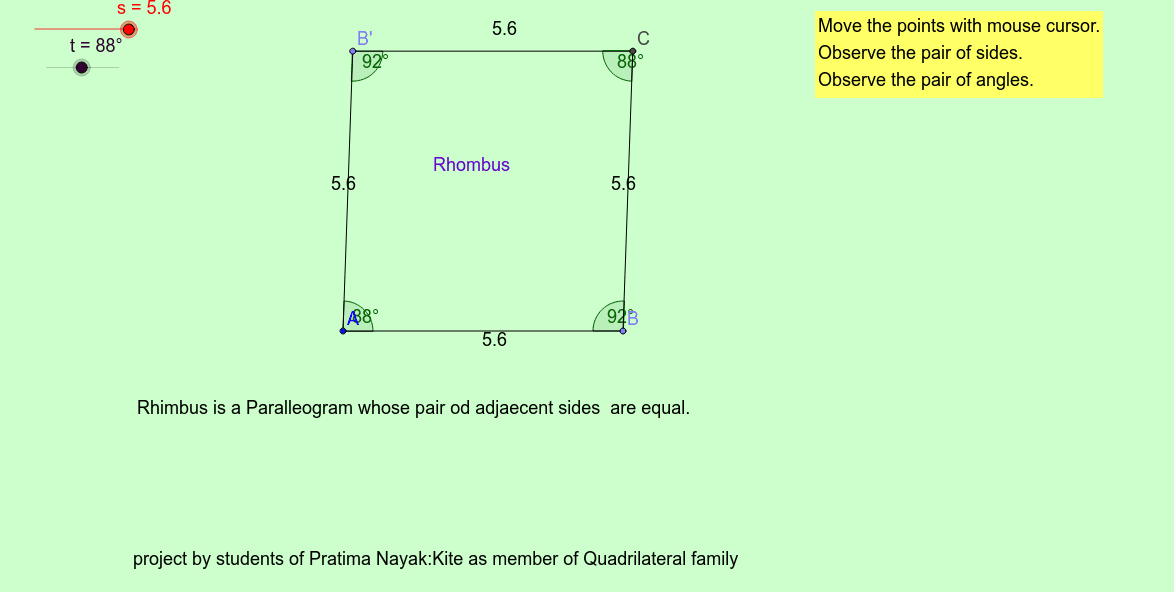
This example demonstrates the geometric properties of a rhombus, including side lengths, angles, and the relationships between diagonals. Key mathematical concepts involve parallelograms, symmetry, angle relationships, and the perpendicular bisectors of diagonals. The construction utilizes GeoGebra commands and objects such as Point, Segment, Rotate, Angle, Line, and Intersect. It is suitable for middle school and above mathematics education, aiding students in understanding rhombus geometry and construction methods.
GeoGebra Commands & Parameters
Point(Circle[A, abs(s)]) → BSegment(A, B) → aRotate(B, t, A) → B'Angle(B, A, B') → αSegment(B', A) → bLine(B, b) → cLine(B', a) → dIntersect(d, c) → CSegment(C, B') → eSegment(C, B) → fAngle(A, B, C) → βAngle(B, C, B') → γAngle(A, B', C) → δ
AI Drawing Prompt Reference
Draw a rhombus to demonstrate equal side lengths and the perpendicular bisectors of diagonals. Start by plotting a point on a circle centered at a vertex with a radius controlled by a slider. Connect and rotate this point to form the rhombus, then draw the diagonals and their intersection point. Connect the intersection to complete the rhombus, labeling key angles and relationships.
The prompt above was compiled from the original drawing commands and is for reference only.