
Properties of Rectangles
Loading the math board and drawing, please wait…
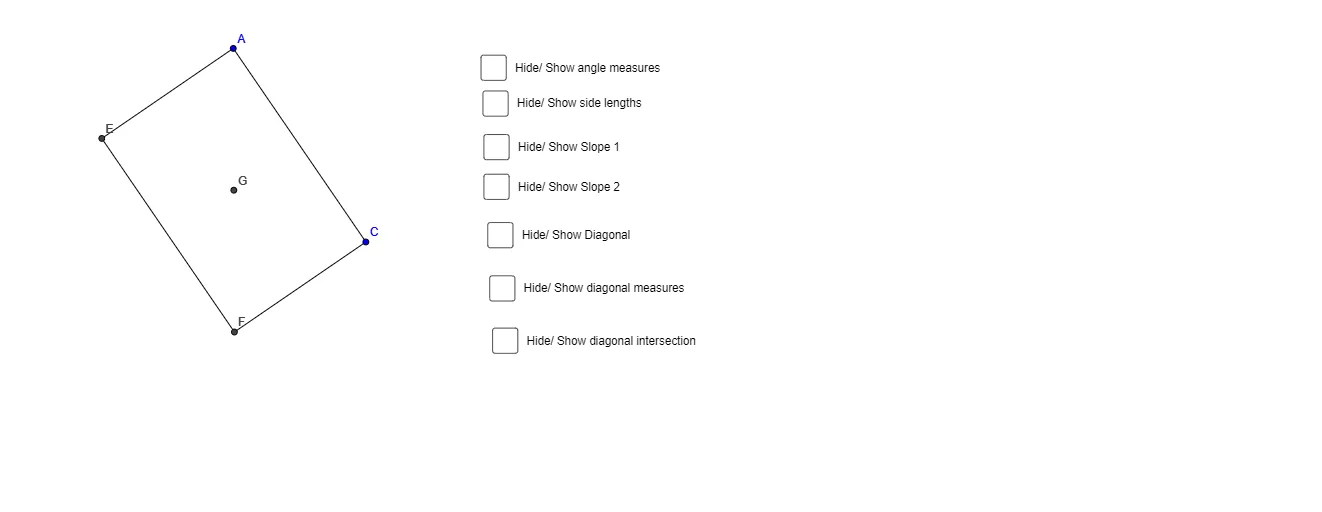
①This GeoGebra example dynamically demonstrates the fundamental properties of a rectangle, including opposite sides parallel and equal, all four angles being right angles, and diagonals equal in length and bisecting each other. ②Core mathematical concepts covered are the definition of a rectangle, parallel and perpendicular lines, angle measurement, distance calculation, and slope, linking to polygon properties and geometric construction. ③Construction details: Based on the summary, commands such as Segment, OrthogonalLine, Line, Intersect, Angle, Distance, and Slope are used to create vertices A, B, C, D and auxiliary points E, F, G, measure side lengths, diagonal lengths, and angles, and display distance values via text objects. ④This is suitable for middle school geometry or introductory high school analytic geometry, helping students verify rectangle properties interactively by dragging vertices, and can serve as a dynamic teaching demonstration.
GeoGebra Commands & Parameters
Segment(A, C) → aOrthogonalLine(A, a) → bOrthogonalLine(C, a) → cLine(D, a) → dIntersect(b, d) → EIntersect(c, d) → FSegment(E, A) → eSegment(F, C) → fSegment(F, E) → gAngle(E, A, C) → αAngle(A, C, F) → βAngle(C, F, E) → γAngle(F, E, A) → δDistance(E, A) → distanceEADistance(A, C) → distanceACDistance(C, F) → distanceCFDistance(F, E) → distanceFESlope(e) → mSlope(f) → m_1Slope(a) → m_2Slope(g) → m_3Segment(E, C) → lSegment(F, A) → nIntersect(l, n) → GDistance(A, G) → distanceAGDistance(G, F) → distanceGFDistance(C, G) → distanceCGDistance(G, E) → distanceGEAngle(A, G, E) → ε
AI Drawing Prompt Reference
Draw a rectangle by first creating a base segment, then constructing perpendicular lines at both endpoints, and a parallel line above to intersect them, forming four vertices. Connect the vertices to form the rectangle, marking all four interior angles as right angles. Measure and display the lengths of all four sides, both diagonals, and the four segments created by the diagonal intersection, verifying that diagonals are equal and bisect each other. Also show the slopes of the sides and label the intersection point of the diagonals.
The prompt above was compiled from the original drawing commands and is for reference only.