
Properties of a Trapezoid
Loading the math board and drawing, please wait…
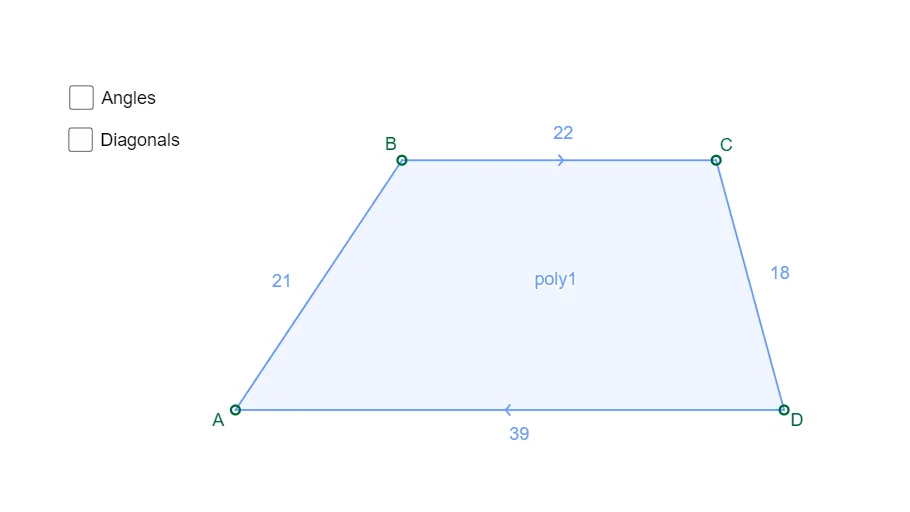
①This GeoGebra example dynamically demonstrates the fundamental properties of a trapezoid, including the parallelism of the two bases, relationships among legs and diagonals, and the sum of interior angles. ②Core mathematical concepts covered include the definition of a trapezoid, properties of parallel lines, the interior angle sum theorem, similar triangles, and area relationships, with a dilation transformation to observe shape changes. ③Construction highlights: Based on the construction summary, commands such as Point, Ray, Polygon, Segment, Intersect, Angle, and Distance are used to create vertices A, B, C, D and auxiliary points, build polygon poly1 with segments a_1, b_1, etc., label interior angles α, β, γ, and measure side lengths, making the construction clear and interactive. ④Suitable for middle and high school geometry classes, this example serves as a visual aid for teaching trapezoid properties, encouraging students to explore invariants under dynamic changes, and can also be used as a model for geometric construction practice.
GeoGebra Commands & Parameters
Point(a) → APoint(a) → ZRay(A, Z) → bPoint(b) → DPoint(c) → YRay(B, Y) → dPoint(d) → CPolygon(A, B, C, D) → poly1, a_1, b_1, c_1, d_1Segment(B, D) → eSegment(C, A) → fIntersect(e, f) → XSegment(A, X) → gSegment(X, C) → jSegment(X, B) → kSegment(X, D) → lAngle(A, X, D) → αAngle(A, B, C) → βAngle(B, C, D) → γAngle(C, D, A) → δAngle(D, A, B) → εAngle(X, B, C) → ζAngle(B, C, X) → ηAngle(X, C, D) → θAngle(C, D, X) → ιAngle(X, D, A) → κAngle(D, A, X) → λAngle(X, A, B) → μAngle(A, B, X) → νDistance(a_1, b_1) → m
AI Drawing Prompt Reference
Draw a trapezoid with two parallel bases. Start by creating two parallel horizontal lines, then place two points on each line to form the four vertices of the trapezoid, connecting them in order to form the quadrilateral. Draw both diagonals and mark their intersection point. From this intersection, draw segments to each of the four vertices, dividing the trapezoid into smaller triangles. Label the interior angles at each vertex of the trapezoid, as well as the angles formed around the intersection point. Also measure and display the distance between the two parallel bases. The figure should clearly show the parallel sides, diagonal relationships, and angle measures.
The prompt above was compiled from the original drawing commands and is for reference only.