
Properties of Parallelograms Part 2
Loading the math board and drawing, please wait…
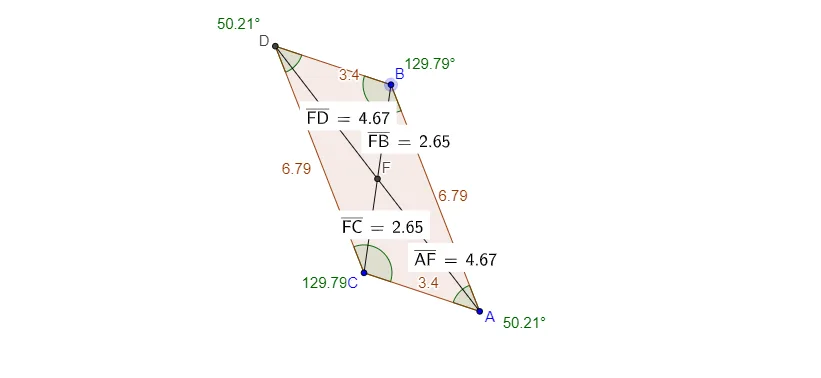
① This interactive GeoGebra example demonstrates the fundamental properties of parallelograms, including opposite sides parallel and equal, opposite angles equal, and diagonals bisecting each other, with dynamic measurements. ② Core mathematical concepts include parallelogram definitions and theorems, congruent triangles, diagonal properties, and verification of geometric relationships through distance measurements. ③ Construction details: using GeoGebra commands such as Line, Intersect, Polygon, Angle, Distance, and Segment to build the parallelogram and its diagonals, with text objects (TextAF, TextFB, etc.) displaying real-time distances along sides and diagonals to support observation. ④ Suitable for middle school geometry instruction or self-study, this example helps students intuitively grasp parallelogram properties and encourages inquiry-based learning by comparing measured values.
GeoGebra Commands & Parameters
Line(A, B) → aLine(C, a) → bLine(A, C) → cLine(B, c) → dIntersect(b, d) → DPolygon(A, B, D, C) → poly1, a_1, b_1, d_1, c_1Angle(A, B, D) → αAngle(B, D, C) → βAngle(C, A, B) → γAngle(A, C, D) → δAngle(A, D, C) → εAngle(A, D, C) → ζAngle(D, C, A) → ηDistance(d_1, c_1) → eDistance(b_1, a_1) → fSegment(D, A) → gSegment(C, B) → hIntersect(g, h) → FDistance(A, F) → distanceAFDistance(F, B) → distanceFBDistance(F, D) → distanceFDDistance(F, C) → distanceFC
AI Drawing Prompt Reference
Draw a parallelogram ABCD, connect its diagonals AC and BD, measure and display the lengths of AB and CD, and the distances from the intersection point F of the diagonals to each vertex.
The prompt above was compiled from the original drawing commands and is for reference only.