
Properties of Parallelograms Part 1
Loading the math board and drawing, please wait…
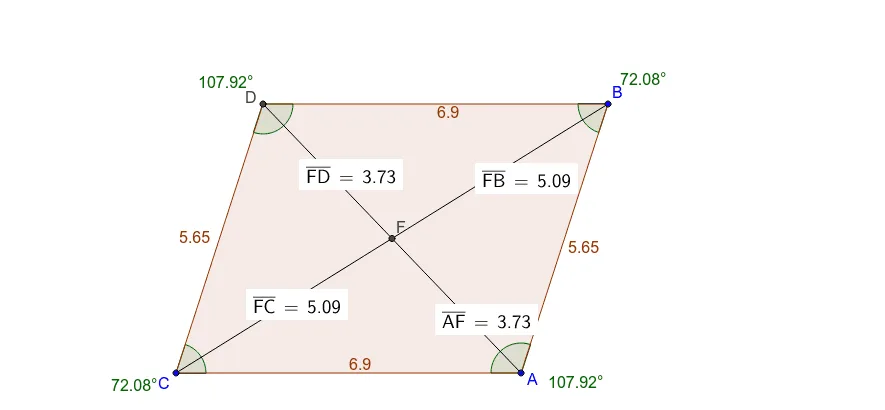
This interactive GeoGebra example demonstrates the fundamental properties of parallelograms, including opposite sides being parallel and equal, opposite angles being equal, consecutive angles being supplementary, and diagonals bisecting each other. By constructing a dynamic parallelogram with draggable vertices, the applet displays real-time measurements of side lengths, angle values, and the distances from the diagonal intersection to each vertex, allowing learners to verify that these properties remain invariant under continuous deformation. The construction employs GeoGebra commands such as Line, Intersect, Polygon, Angle, Distance, and Segment, creating points A, B, C, D, sides a, b, c, d, diagonals e, f, g, h, intersection points E and F, and labeled angles α, β, γ, δ, ε, ζ, η. It is ideal for middle school or high school geometry classes, serving as a visual proof and exploratory tool for students to grasp the defining characteristics of parallelograms, and can be used for guided discovery, homework, or classroom demonstration.
GeoGebra Commands & Parameters
Line(A, B) → aLine(C, a) → bLine(A, C) → cLine(B, c) → dIntersect(b, d) → DPolygon(A, B, D, C) → poly1, a_1, b_1, d_1, c_1Angle(A, B, D) → αAngle(B, D, C) → βAngle(C, A, B) → γAngle(A, C, D) → δAngle(A, D, C) → εAngle(A, D, C) → ζAngle(D, C, A) → ηDistance(c_1, d_1) → eDistance(a_1, b_1) → fSegment(D, A) → gSegment(C, B) → hIntersect(g, h) → FDistance(A, F) → distanceAFDistance(F, B) → distanceFBDistance(F, D) → distanceFDDistance(F, C) → distanceFC
AI Drawing Prompt Reference
Create a draggable parallelogram in the plane with four vertices connected to form the polygon. Draw both diagonals so they intersect at a single center point, and depict the relationships by showing the diagonal intersection connecting to the involved vertices via distance measurements. Label several angles formed by vertices and diagonal/side directions, placing angle value markers around the relevant vertex configurations to reflect equal opposite angles and supplementary consecutive angles. Keep the construction dynamic so the measurements update as the parallelogram deforms.
The prompt above was compiled from the original drawing commands and is for reference only.