
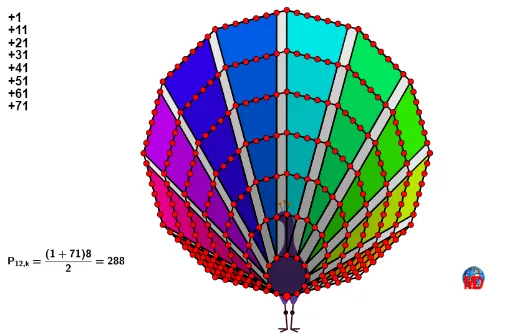
Properties of N-gonal Numbers (Peacock Theorem)
Loading the math board and drawing, please wait…
This example demonstrates the properties of N-gonal numbers, involving concepts such as sequences, rotation, and sum. Using GeoGebra commands like Sequence, Sum, and Rotate, the construction of N-gonal numbers is illustrated. Suitable for high school mathematics education and learning.
GeoGebra Commands & Parameters
Sequence((1; (i * α)), i, 0, n - 2) → vrepartSequence(Sum[vrepart, i], i, 1, n - 1) → srepartSequence(((n - 2) * i) - n + 3, i, 1, k) → suiteSum(suite) → aSequence(A + (i; 0), i, 0, k - 1) → lhorizSequence(Polygon[A + (0, 0), A + (i; 0), n], i, 1, k - 1) → l1Sequence(Sequence[Sequence[A + (i * Element[srepart, j - 1]) + (t * Element[vrepart, j]), t, 1, i], j, 2, n - 1], i, 0, k - 1) → l2Rotate(l1, π / n, A) → l1'Sequence(Rotate[Element[l2, i], π / n, A], i, 1, Length[l2]) → l2'Rotate(lhoriz, π / n, A) → lhoriz'Sequence(Sequence[Polygon[Element[Element[Element[l2, 2], i], 1], Element[Element[Element[l2, m], i], 1], Element[Element[Element[l2, m], i], m - 1]], m, 2, k], i, 1, n - 2) → l4Sequence(Rotate[Element[l4, i], π / n, A], i, 1, Length[l4]) → l4'Element(l4', A1) → B1Element(l4', A2) → B2Element(l4', A3) → B3Element(l4', A4) → B4Element(l4', A5) → B5Element(l4', A6) → B6Element(l4', A7) → B7Element(l4', A8) → B8Element(l4', A9) → B9Element(l4', A10) → B10Element(l4', A11) → B11Element(l4', A12) → B12Element(l4', A13) → B13Element(l4', A14) → B14Element(l4', A15) → B15Sequence(F - (0, (1.2 * i)), i, 0, k) → l3Sequence(Text[" +" + (Element[suite, i]), Element[l3, i + 1] + (0.2, -0.1)], i, 1, n - 1) → l5
AI Drawing Prompt Reference
Draw a diagram illustrating the properties of N-gonal numbers, involving sequences and rotation, with sums and rotations constructing the N-gonal numbers, and label the key steps for high school mathematics education.
The prompt above was compiled from the original drawing commands and is for reference only.