
Properties of a Rhombus
Loading the math board and drawing, please wait…
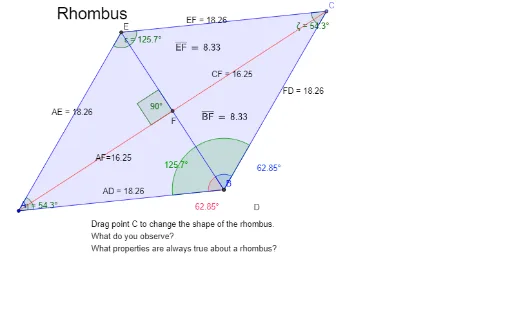
This example demonstrates the geometric properties of a rhombus, including side lengths, angles, and diagonal relationships. Key math concepts involved are polygons, angles, distances, midpoints, rotations, isosceles triangles, centroids, and rational numbers. Construction highlights include using GeoGebra commands like Circle, Point, Intersect, Polygon, Segment, Angle, Distance, and Midpoint. Suitable for middle school and above students learning geometric constructions and property exploration.
GeoGebra Commands & Parameters
Circle(A, Segment[A, B]) → cCircle(B, Segment[A, B]) → dPoint(d) → CCircle(C, Segment[C, B]) → eIntersect(e, c) → D, E, ,Polygon(E, A, B, C) → poly1, e_1, a, b, c_1Segment(C, A) → fSegment(B, E) → gAngle(g, f) → αDistance(g, f) → hIntersect(g, f) → FDistance(B, F) → distanceBFDistance(E, F) → distanceEFAngle(C, B, A) → βAngle(F, B, A) → γAngle(C, B, F) → δDistance(A, F) → iDistance(C, F) → jSegment(A, F) → kMidpoint(k) → GSegment(F, C) → lMidpoint(l) → HAngle(A, E, C) → εAngle(E, C, B) → ζAngle(B, A, E) → η
AI Drawing Prompt Reference
Draw a rhombus to demonstrate its geometric properties, including side lengths, angles, and diagonal relationships. Start by drawing two intersecting circles to form the vertices of the rhombus. Measure and label the lengths of all sides, the sizes of the angles, and the relationships at the intersection of the diagonals. Identify the midpoints of the diagonals, the centroid, and the triangles formed by connecting these points. Finally, show that the diagonals are perpendicular bisectors of each other and divide the rhombus into four congruent right triangles.
The prompt above was compiled from the original drawing commands and is for reference only.