
Properties of a Rhombus by jeanne kelly
Loading the math board and drawing, please wait…
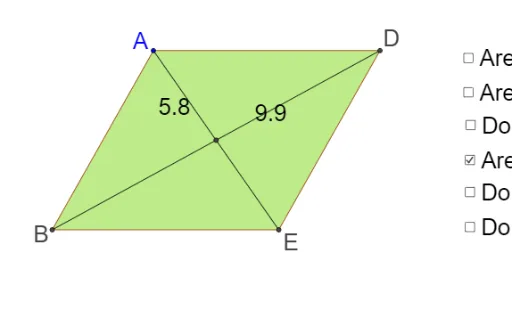
This example demonstrates the fundamental properties of a rhombus, including equal side lengths, perpendicular and bisecting diagonals, and angle bisectors. Key mathematical concepts involved are parallelograms, rotational symmetry, angle calculations, and geometric constructions. The construction utilizes GeoGebra commands like Intersect, Line, Point, Polygon, Segment, and Angle. It is suitable for middle school students and above, particularly for learning rhombus properties and geometric constructions in high school mathematics.
GeoGebra Commands & Parameters
Intersect(xAxis, yAxis) → BLine(B, A) → aLine(A, xAxis) → bLine(B, b) → cPoint(c) → CLine(C, a) → dIntersect(b, d) → DIntersect(c, d) → EPolygon(B, A, D, E) → poly1, b_1, a_1, d_1, eSegment(B, D) → fSegment(A, E) → gIntersect(f, g) → FSegment(B, F) → hSegment(F, D) → iSegment(E, F) → jSegment(F, A) → kAngle(E, F, D) → αAngle(D, F, A) → βAngle(A, F, B) → γAngle(B, F, E) → δAngle(D, E, B) → εAngle(B, A, D) → ζAngle(A, D, E) → ηAngle(E, B, A) → θAngle(E, B, F) → ιAngle(F, B, A) → κAngle(B, A, F) → λAngle(F, A, D) → μAngle(F, E, B) → νAngle(D, E, F) → ξAngle(F, D, E) → οAngle(A, D, F) → ρPolygon(A, D, E, B) → poly2, a_2, d_2, e_1, b_2Segment(A, E) → pSegment(B, D) → sSegment(A, E) → rSegment(B, D) → c_1