
Properties of a Rhombus by Alfred Estberg
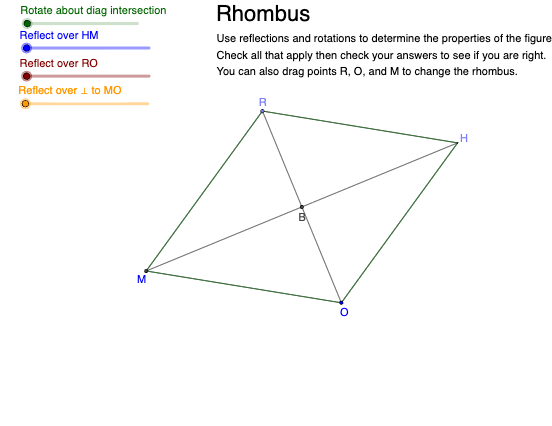
Loading the math board and drawing, please wait…
This example demonstrates the properties of a rhombus. Key mathematical concepts include similarity transformation, rectangles, and special points. Using GeoGebra commands such as Circle, Point, Segment, Line, Intersect, Polygon, Rotate, etc., the construction of a rhombus and the observation of its properties are illustrated. Suitable for middle school and above students to learn geometric construction.
GeoGebra Commands & Parameters
Circle(M, O) → cPoint(c) → RSegment(M, O) → aSegment(M, R) → bLine(O, b) → dLine(R, a) → eIntersect(d, e) → HSegment(O, H) → fSegment(H, R) → gPolygon(M, O, H, R) → poly1, a_1, b_1, c_1, d_1Segment(M, H) → hSegment(O, R) → iIntersect(h, i) → ECircle(O, (Distance[O, R] * ReflectAC / 10)) → kIntersect(k, i) → F, H_1Polygon(M, F, H) → poly2, m, n, qCircle(M, (Distance[M, H] * ReflectBD / 10)) → pIntersect(p, h) → G, IPolygon(R, G, O) → poly3, r, s, tRotate(M, α, E) → A'Rotate(O, α, E) → B'Rotate(H, α, E) → C'Rotate(R, α, E) → D'Polygon(A', B', C', D') → poly1', a', b', c', d'Segment(A', C') → jSegment(B', D') → lIntersect(h, i) → BPoint(a) → AOrthogonalLine(A, a) → f_1Circle(M, ((2 * ReflectPerp) * Segment[A, M])) → e_1Intersect(f_1, g) → CCircle(R, ((ReflectPerp * 2) * Segment[R, C])) → g_1Intersect(g_1, g, 1) → DIntersect(e_1, Ray[M, O], 1) → JPolygon(A, C, D, J) → q1, a_2, c_2, d_2, j_2
AI Drawing Prompt Reference
Draw a rhombus formed by points M, O, H, and R. Inside the rhombus, there are line segments a and b, and a line d. The center point O is connected to point R via line i. Line segments h and i intersect at point E. A circle is drawn with center O and radius equal to Distance[O, R] multiplied by ReflectAC divided by 10. This circle intersects line i at points F and H_1. Another circle with center M and radius Distance[M, H] multiplied by ReflectBD divided by 10 intersects line h at points G and I. The vertices R, G, O form a triangle. The vertices M, F, H form another triangle. The vertices A, C, D, J form a quadrilateral. Inside the rhombus, there are line segments j and l, and points C and D. There are also line segments f_1 and g, and points C and D. There are circles e_1 and g_1, and points C and D. There is a ray J and point J. The rhombus contains points A, C, D, J forming a quadrilateral. The rhombus contains line segments j and l, and points C and D. The rhombus contains line segments f_1 and g, and points C and D. The rhombus contains circles e_1 and g_1, and points C and D. The rhombus contains ray J and point J. The rhombus contains points A, C, D, J forming a quadrilateral.
The prompt above was compiled from the original drawing commands and is for reference only.