
Properties of a Rhombus by Adam Bevan
Loading the math board and drawing, please wait…
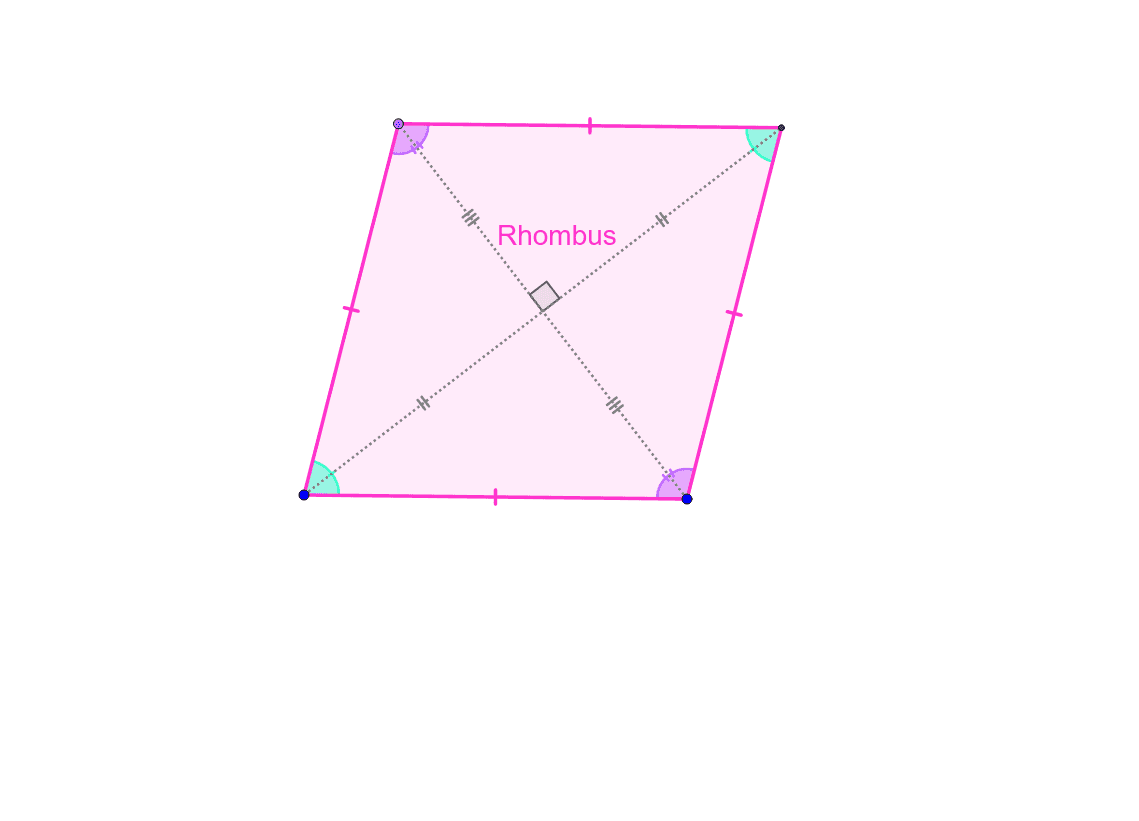
This example demonstrates the geometric properties of a rhombus, including side lengths, angles, and the relationships between diagonals. Key mathematical concepts involve parallelograms, symmetry, angle relationships, and the perpendicular bisectors of diagonals. The construction utilizes GeoGebra commands/objects such as Segment, Circle, Point, Line, Intersect, Polygon, and Angle. It is suitable for middle school and above students to learn and understand the geometric characteristics of rhombuses, as well as for mathematical teaching demonstrations.
GeoGebra Commands & Parameters
Segment(A, B) → aCircle(A, B) → cPoint(c) → CSegment(A, C) → bLine(B, b) → dLine(C, a) → eIntersect(d, e) → DPolygon(C, A, B, D) → Rhombus, c_1, a_1, b_1, d_1Angle(Rhombus) → α, β, γ, δSegment(A, D) → fSegment(C, B) → gIntersect(f, g) → ESegment(A, E) → hSegment(E, D) → iSegment(B, E) → jSegment(E, C) → kAngle(D, E, C) → ε
AI Drawing Prompt Reference
Draw a rhombus with points A, B, C, and D, where AB and AD are the sides of the rhombus, and AC and BD are the diagonals that are perpendicular and bisect each other. Connect points A, B, C, and D to form the rhombus, measure the four interior angles α, β, γ, δ, and the intersection point E of diagonals AC and BD, then connect AE, ED, EB, and EC, and measure angle ε.
The prompt above was compiled from the original drawing commands and is for reference only.