
Properties of a Kite by Adam Bevan
Loading the math board and drawing, please wait…
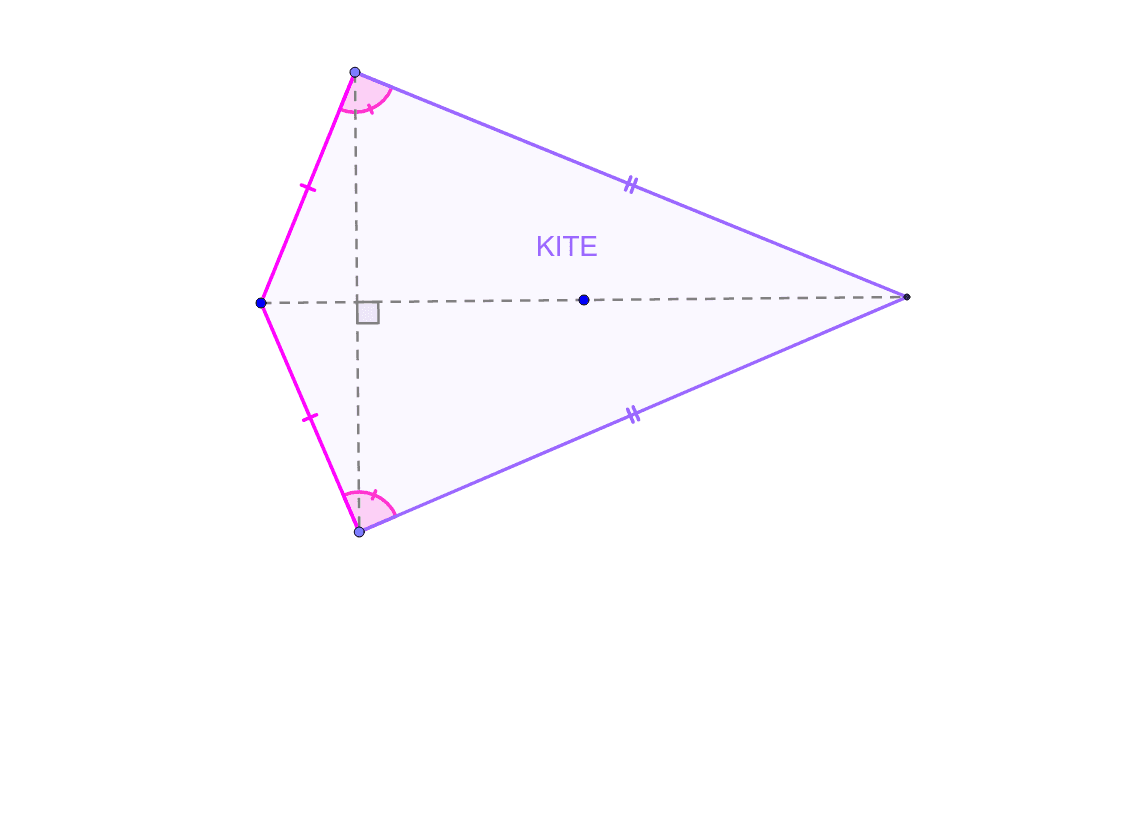
This example demonstrates the properties of a kite shape. The core mathematical concepts involved include polygons, angles, and symmetry. Key points in construction: GeoGebra commands used are Ray, Circle, Intersect, Point, Mirror, Polygon, Segment, Angle; objects include A, B, a, c, C, D, D', KITE, d, a_1, d', c_1, b, e, α, β, γ. Suitable for high school mathematics courses to help students understand the geometric properties and construction methods of kites.
GeoGebra Commands & Parameters
Ray(A, B) → aCircle(B, A) → cIntersect(c, a, 2) → CPoint(c) → DMirror(D, a) → D'Polygon(D, A, D', C) → KITE, d, a_1, d', c_1Segment(D, D') → bSegment(A, C) → eAngle(A, D, C) → αAngle(C, D', A) → βAngle(b, e) → γ
AI Drawing Prompt Reference
Start with two points. Draw a circle centered at the second point passing through the first point. Draw a ray from the first point through the second point, and take the other intersection of this ray with the circle. Choose any point on the circle, reflect it across the ray, and connect the chosen point, the first point, the reflected point, and the ray-circle intersection in order to form a kite. Add the segment joining the chosen point to its reflection and the segment joining the first point to the ray-circle intersection. Mark the angle at the chosen point formed by the first point and the ray-circle intersection, the angle at the reflected point formed by the ray-circle intersection and the first point, and the angle between the two added segments.
The prompt above was compiled from the original drawing commands and is for reference only.