
Straight Lines Intersected by a Transversal
Loading the math board and drawing, please wait…
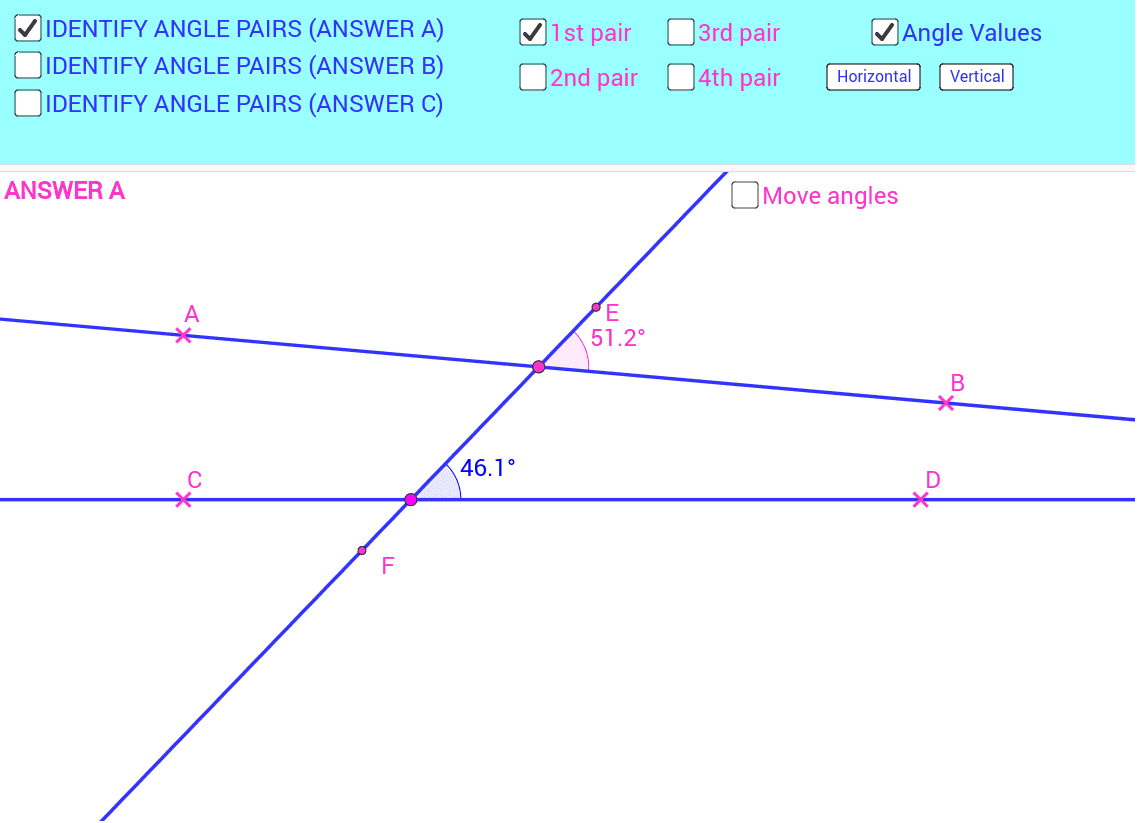
This example demonstrates the angles formed when straight lines are intersected by a transversal. Key mathematical concepts include parallel lines, corresponding angles, alternate interior angles, and same-side interior angles. Using GeoGebra commands such as Point, Line, and Intersect, dynamic displays of these angles are shown. Suitable for middle school and above students learning geometry.
GeoGebra Commands & Parameters
Point(Segment[C, D]) → YPoint(Segment[A, B]) → XLine(X, Y) → c_1Intersect(Line[A, Line[C, D]], OrthogonalLine[B, Line[A, Line[C, D]]]) → B'Intersect(Line[B, Line[C, D]], OrthogonalLine[A, Line[B, Line[C, D]]]) → A'Intersect(Line[C, Line[A, B]], OrthogonalLine[D, Line[C, Line[A, B]]]) → D'Intersect(Line[D, Line[A, B]], OrthogonalLine[C, Line[D, Line[A, B]]]) → C'Line(A, B) → a_1Line(C, D) → b_1Segment(A, B) → s1Segment(C, D) → s2Point(c_1) → EPoint(c_1) → FPoint(Segment[X, Y]) → HAngle(H + (5 * UnitVector[Segment[C, D]]), H, H + (5 * UnitVector[Segment[F, E]])) → bRay(H, Vector[UnitVector[Segment[C, D]]]) → f_1Point(Segment[X, Y]) → IAngle(I + (5 * UnitVector[Segment[F, E]]), I, I + (5 * UnitVector[Segment[B, A]])) → cRay(I, Vector[UnitVector[Segment[B, A]]]) → g_1Point(Segment[X, Y]) → JAngle(J + (5 * UnitVector[Segment[F, E]]), J, J + (5 * UnitVector[Segment[D, C]])) → dPoint(Segment[X, Y]) → KRay(J, Vector[UnitVector[Segment[D, C]]]) → h_1Angle(K + (5 * UnitVector[Segment[E, F]]), K, K + (5 * UnitVector[Segment[A, B]])) → eRay(K, Vector[UnitVector[Segment[A, B]]]) → iPoint(Segment[X, Y]) → LAngle(L + (5 * UnitVector[Segment[E, F]]), L, L + (5 * UnitVector[Segment[C, D]])) → fRay(L, Vector[UnitVector[Segment[C, D]]]) → jPoint(Segment[X, Y]) → MAngle(M + (5 * UnitVector[Segment[B, A]]), M, M + (5 * UnitVector[Segment[E, F]])) → gRay(M, Vector[UnitVector[Segment[B, A]]]) → kPoint(Segment[X, Y]) → NAngle(N + (5 * UnitVector[Segment[D, C]]), N, N + (5 * UnitVector[Segment[E, F]])) → hRay(N, Vector[UnitVector[Segment[D, C]]]) → lPoint(Segment[X, Y]) → GAngle(G + (5 * UnitVector[Segment[A, B]]), G, G + (5 * UnitVector[Segment[F, E]])) → aRay(G, Vector[UnitVector[Segment[A, B]]]) → nCorner(1) → C1Corner(2) → C2Corner(3) → C3Corner(4) → C4