
Properties of a Regular Hexagon
Loading the math board and drawing, please wait…
In collections
Folding paper, doing geometry figures
This example demonstrates the properties of a regular hexagon, including side lengths, diagonal lengths, and interior and exterior angles. Key mathematical concepts include polygons, angles, and geometric construction. It uses commands like Polygon, Midpoint, Rotate, CircleArc, and Intersect in GeoGebra for construction. Suitable for students at the middle school level and above to learn about the properties of geometric shapes.
GeoGebra Commands & Parameters
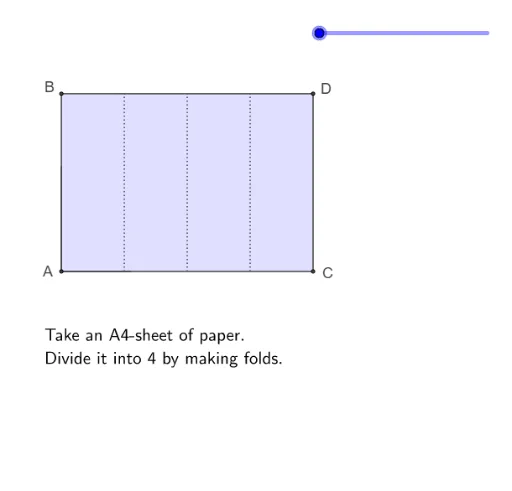
Polygon(A, C, D, B) → vierhoek1, a, c, d, bSegment((sqrt(2) / 4, 0), (sqrt(2) / 4, 1)) → fSegment((sqrt(2) / 2, 0), (sqrt(2) / 2, 1)) → gSegment(((3 * sqrt(2) / 4), 0), ((3 * sqrt(2) / 4), 1)) → hMidpoint(B, D) → ERotate(D, -90°, E) → DDCircleArc(E, DD, D) → eIntersect(e, h, 1) → FCircleArc(E, F, D) → kAngularBisector(F, E, D) → iIntersect(i, c) → GSegment(E, G) → jPolygon(A, C, G, E, B) → veelhoek1, a_1, c_1, g_1, e_1, b_1Polygon(E, D, G) → driehoek1, g_2, e_2, d_1Rotate(E, (((-(s - 1)) * 180))°, g_1) → E'Rotate(D, (((-(s - 1)) * 180))°, g_1) → D'Rotate(G, (((-(s - 1)) * 180))°, g_1) → G'Polygon(E', D', G') → driehoek1', g', e', d'Polygon(E, F, G) → driehoek2, g_3, e_3, f_1Segment(E, D) → lSegment(D, G) → mOrthogonalLine(F, a_1) → nIntersect(j, d') → IIIntersect(n, j) → RIntersect(n, a_1) → SSegment(R, S) → pSegment(F, S) → qMirror(F, g) → HMirror(G, g) → ISegment(I, E) → rCircleArc(E, B, H) → tPolygon(I, E, B) → driehoek3, b_2, i_1, e_4Rotate(I, (((s - 3) * 180))°, r) → I'Rotate(E, (((s - 3) * 180))°, r) → E'_1Rotate(B, (((s - 3) * 180))°, r) → B'Polygon(I', E'_1, B') → driehoek3', b', i', e'_1Polygon(E, I, A, C, G) → veelhoek2, e_5, i_2, a_2, c_2, g_4Segment(B, E) → h_1Segment(B, I) → j_1Mirror(R, g) → TTMirror(S, g) → SSSegment(SS, TT) → k_1Segment(SS, H) → l_1Polygon(I, H, E) → driehoek4, e_6, i_3, h_2Circle(G, C) → p_1Intersect(d', f_1) → JIntersect(d', f_1) → KIntersect(d', f_1) → LIntersect(d', f_1) → MIntersect(p_1, f_1) → N,CircleArc(G, N, C) → q_1Line(G, F) → m_1Intersect(m_1, a_2) → OSegment(O, F) → n_1Polygon(O, C, G) → driehoek5, g_5, o, c_3Rotate(O, (((s - 5) * 180))°, c_3) → O'Rotate(C, (((s - 5) * 180))°, c_3) → C'Rotate(G, (((s - 5) * 180))°, c_3) → G'_1Polygon(O', C', G'_1) → driehoek5', g'_1, o', c'Polygon(I, A, O, G, E) → veelhoek3, i_4, a_3, o_1, g_6, e_7Mirror(O, n_1) → O'_1Mirror(C, n_1) → C'_1Mirror(G, n_1) → G'_2Polygon(O'_1, C'_1, G'_2) → driehoek5'_1, g'_2, o'_1, c'_1Mirror(O, g) → O'_2Mirror(C, g) → C'_2Mirror(G, g) → G'_3Polygon(O'_2, C'_2, G'_3) → driehoek5'_2, g'_3, o'_2, c'_2Rotate(O, (((s - 5) * 180))°, c_3) → O'_3Rotate(G, (((s - 5) * 180))°, c_3) → G'_4Rotate(O'_2, (((-(s - 6)) * 180))°, c'_2) → QRotate(G'_3, (((-(s - 6)) * 180))°, c'_2) → UIntersect(c', o_1) → VIntersect(c', o_1) → WIntersect(c', o_1) → ZLine(I, H) → r_1Intersect(o_1, r_1) → TSegment(O, C) → s_1Segment(C, G) → t_1Polygon(I, A, O, T) → vierhoek2, i_5, a_4, o_2, t_2Rotate(I, (((-(s - 7)) * 180))°, t_2) → I'_1Rotate(A, (((-(s - 7)) * 180))°, t_2) → A'Rotate(O, (((-(s - 7)) * 180))°, t_2) → O'_4Rotate(T, (((-(s - 7)) * 180))°, t_2) → T'Polygon(I, T, G, E) → vierhoek3, i_6, t_3, g_7, e_8Segment(E, T) → f_2Segment(T, E) → j_2Intersect(Segment[O, N], j_2) → A_1Segment(A_1, E) → k_2Rotate(I, (((-(s - 7)) * 180))°, i_6) → I'_2Rotate(A, (((-(s - 7)) * 180))°, i_6) → A'_1Rotate(O, (((-(s - 7)) * 180))°, i_6) → O'_5Rotate(T, (((-(s - 7)) * 180))°, i_6) → T'_1Polygon(I'_2, A'_1, O'_5, T'_1) → vierhoek2', i'_2, a'_1, o'_5, t'_1Mirror(N, g) → NNCircleArc(I, A, NN) → d_2Segment(I, T) → l_2Intersect(g'_2, l_2) → B_1Polygon(N, B_1, T, G) → vierhoek4, n_2, b_3, t_4, g_8Segment(I, A) → m_2Segment(A, O) → p_2Mirror(H, Segment[I, G]) → HHMirror(HH, g) → GGIntersect(n_2, g) → C_1Polygon(I, T, C_1, NN) → vierhoek5, i_7, t_5, c_4, nnSegment(HH, H) → q_2Segment(GG, F) → r_2Polygon(GG, F, G) → driehoek6, g_9, gg, f_3Polygon(I, H, HH) → driehoek7, hh, i_8, h_3Rotate(GG, (((s - 9) * 180))°, q) → GG'Rotate(F, (((s - 9) * 180))°, q) → F'Rotate(G, (((s - 9) * 180))°, q) → G'_5Polygon(GG', F', G'_5) → driehoek6', g'_5, gg', f'Rotate(I, (((s - 9) * 180))°, f) → I'_3Rotate(H, (((s - 9) * 180))°, f) → H'Rotate(HH, (((s - 9) * 180))°, f) → HH'Polygon(I'_3, H', HH') → driehoek7', hh', i'_3, h'Segment(HH, E) → s_2Segment(H, B_1) → j_3Segment(E, GG) → k_3Segment(T, F) → l_3Polygon(E, HH, H, T, F, GG) → veelhoek4, e_9, hh_1, h_4, t_6, f_4, gg_1Segment(C_1, T) → m_3Angle(HH, E, GG) → αAngle(HH, E, GG) → βAngle(H', HH, E) → γAngle(T, H', HH) → δAngle(F, T, H') → εAngle(GG, F, T) → ζAngle(E, GG, F) → ηMidpoint(E, T) → MMCircle(MM, E) → d_3Point(d_3) → PPMirror(PP, MM) → PP'Line(PP, PP') → n_3Circle(MM, 0.55) → p_3Line(E, T) → q_3Intersect(p_3, q_3) → F_1, G_1Segment(F_1, G_1) → r_3Sequence(Segment[Rotate[F_1, ((nnn * 30))°, MM], Rotate[G_1, ((nnn * 30))°, MM]], nnn, 1, 6) → lijst_1
AI Drawing Prompt Reference
Draw a regular hexagon with its sides, diagonals, interior angles, and exterior angles. Start by plotting the vertices A, C, D, and B, then connect them to form the hexagon. Construct the diagonals and center point E, and use rotation and symmetry to build the rest of the hexagon, forming multiple triangles and quadrilaterals to demonstrate the symmetry and angle properties of the regular hexagon.
The prompt above was compiled from the original drawing commands and is for reference only.