
Properties of a Parallelogram by Michael Petre
Loading the math board and drawing, please wait…
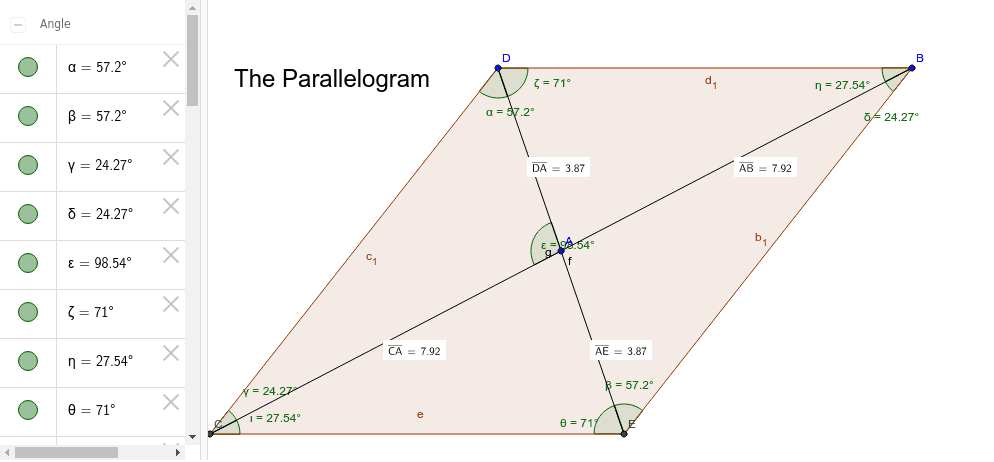
This example demonstrates the relationships between the diagonals and angles of a parallelogram. Key math concepts include the diagonals bisecting each other and the angles being supplementary. It is constructed using commands like Circle, Line, Intersect, Polygon, Segment, Angle, Distance, and Midpoint. Suitable for high school students to learn and understand the geometric properties of parallelograms, ideal for classroom instruction or self-exploration.
GeoGebra Commands & Parameters
Circle(A, B) → cLine(B, A) → aIntersect(c, a, 2) → CCircle(A, D) → dLine(D, A) → bIntersect(d, b, 2) → EPolygon(C, D, B, E) → poly1, c_1, d_1, b_1, eSegment(C, B) → fSegment(D, E) → gAngle(C, D, E) → αAngle(B, E, D) → βAngle(B, C, D) → γAngle(C, B, E) → δAngle(D, A, C) → εAngle(E, D, B) → ζAngle(D, B, C) → ηAngle(D, E, C) → θAngle(E, C, B) → ιDistance(C, A) → distanceCAMidpoint(C, A) →Distance(A, B) → distanceABMidpoint(A, B) →Distance(D, A) → distanceDAMidpoint(D, A) →Distance(A, E) → distanceAEMidpoint(A, E) →
AI Drawing Prompt Reference
Draw a parallelogram to demonstrate the relationships between its diagonals and angles, showing that the diagonals bisect each other and the angles are supplementary. Start by drawing two intersecting line segments. Then, draw circles centered at the intersection point and one endpoint of each segment to find their intersections with the segments. Connect these points to form the parallelogram. Next, draw the diagonals and mark their intersection point. Finally, measure and label the lengths of the diagonals and the angles, verifying that the diagonals bisect each other and the angles are supplementary.
The prompt above was compiled from the original drawing commands and is for reference only.